The Football Mercy Rule, State by State
The NFL has no mercy rule and college can only shorten quarters. High school has fifty answers — here's the running clock rule, state by state.
Article Contents
No, the NFL doesn't have one. College has something, but it isn't what you think. And high school football has about fifty different answers, because every state association writes its own.
That last part is why this page exists. If you're operating a scoreboard on a Friday night and the margin just hit 35, the only rule that matters is your state's — and the number ranges from 30 to 45 depending on where you're standing.
The mercy rule usually doesn't end the game
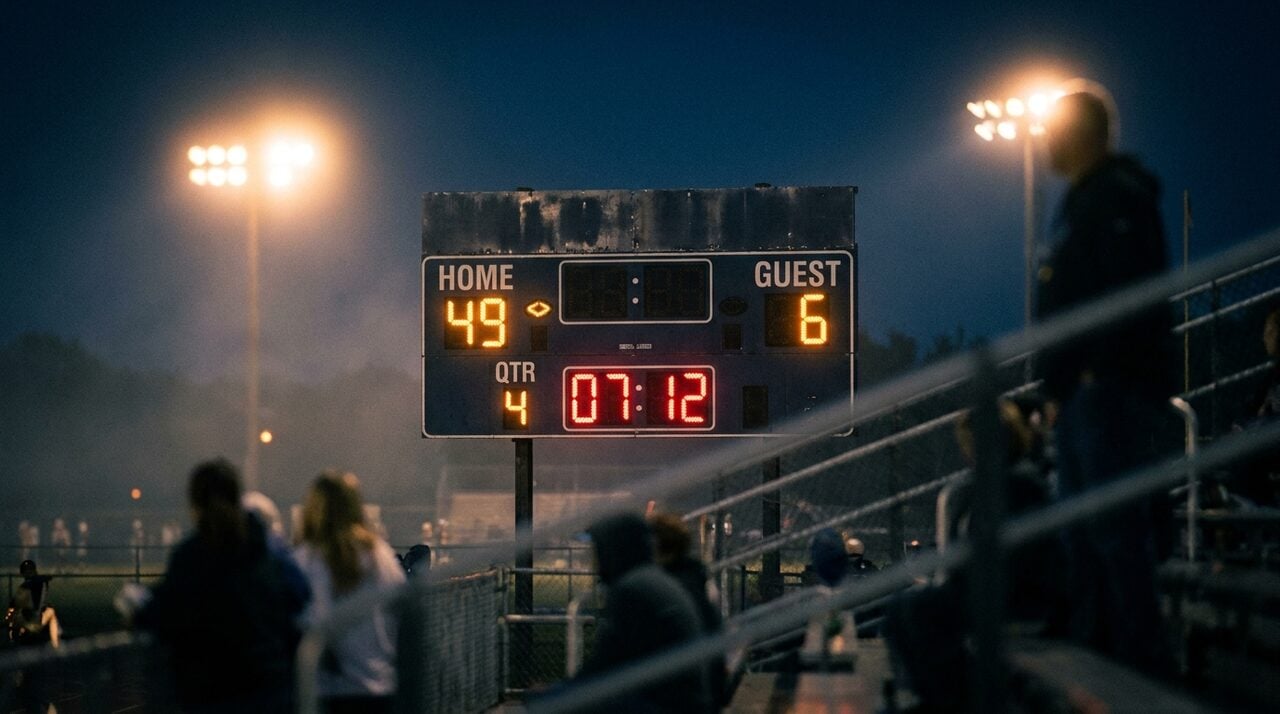
Here's the thing most people get wrong. In football, a mercy rule almost never means "stop playing." It means the clock stops stopping.
Normally the game clock halts constantly — incomplete pass, runner out of bounds, first down, change of possession. Those stoppages are most of why a 48-minute high school game takes two and a half hours. Once the mercy rule kicks in, the clock keeps running through all of them, and stops only for timeouts, injuries and scores. Officials call it a running clock or a continuous clock. The quarters stay the same length. The game just finishes a lot faster.
A handful of states do end games outright. New Mexico stops at 50 points. Utah stops at 45 after the third quarter. But they're the exception, and even those states run the clock first.
NFL: there is no mercy rule
None. No running clock, no early finish, no coaches' agreement. A 59-0 game gets the same four fifteen-minute quarters as a one-point game, with the clock stopping exactly as it always does.
The closest thing the NFL has is the kneel-down, which is a tactic rather than a rule.
College: one rule, and it's narrower than people assume
The NCAA does have a provision, and it's quoted constantly — usually without the part that matters.
NCAA Football Rule 3-2-2-a says: "Any time during the game, the playing time of any remaining period or periods may be shortened by mutual agreement of the opposing head coaches and the referee."
So coaches can agree to cut the quarters short. What they explicitly cannot do is run the clock. Approved Ruling 3-2-2-I in the same book walks through a 56-0 halftime where the coaches ask for shorter quarters and a running clock. The ruling: the quarters may be shortened, "however, the 'running clock' is not allowed; normal clock rules apply for the entire game."
That's the opposite of how high school handles it. High school shortens games by running the clock and leaving the quarters alone. College shortens the quarters and leaves the clock alone.
It gets used, rarely. On 12 September 2024, South Alabama led Northwestern State 80-10 after three quarters, and both coaches agreed to a six-minute fourth. The final was 87-10 — the most points an FBS team had scored since 1991 — in 51 minutes of playing time. Sportsbooks voided bets, because a lot of house rules require 55 minutes for a game to count.
High school: fifty associations, fifty answers
This is where it gets genuinely messy, and where nobody had built a proper table.
The NFHS rulebook doesn't set a mercy rule. Rule 3-1-2 just permits each state association to adopt one, which means fifty separate decisions about the number, when it starts, whether it comes back off, and whether it applies in the playoffs.
The table below covers the 34 states where we read the association's own published rule. Every row links to that document. Verified 21 September 2026 — these change most years, so check the date before you trust it.
| State | Margin | When it starts | What happens |
|---|---|---|---|
| Alabama | None | Only if both coaches agree | Running clock, entirely optional |
| Alaska | 35 | End of 3rd quarter or after | Running clock |
| Arizona | 42 / 35 | 42 in the 1st half, 35 in the 2nd | Running clock; normal timing returns for the last two minutes |
| California (CIF‑SS) | 35 | End of 3rd quarter or after | Running clock, never lifted |
| Colorado | 40 | Any point in the game | Running clock (45 in six-man) |
| Connecticut | 35 | 3rd or 4th quarter | Running clock; lifted if margin drops. Not in state finals |
| Florida | 35 | End of 2nd quarter only | Running clock |
| Georgia | 30 | Trailing coach's choice at half | Optional in the 3rd, mandatory in the 4th |
| Idaho | 40 | Reached any time, starts in the 4th | Running clock. Not in the playoffs |
| Indiana | 35 | 2nd half | Running clock, never lifted; coaches can't override |
| Iowa | 35 | Any time, including the 1st quarter | Running clock; lifted if margin drops |
| Kansas | None / 45 | Playoffs only, 2nd half | No statewide 11-player regular-season rule |
| Kentucky | 35 | Any time | Running clock, never lifted |
| Louisiana | 42 | Any time | Running clock, never lifted. Applies in state finals |
| Maryland | 35 | After the 1st half | Running clock; lifted by a score that closes the gap |
| Michigan | 35 / 50 | 2nd half | Running clock at 35; at 50 it stops only for injuries |
| Minnesota | 35 | 4th quarter only | Running clock; lifted only below 30 |
| Missouri | 35 | After the 1st half | Running clock (45 in eight-man) |
| Nebraska | 35 | After the 1st half | Running clock; lifted if margin drops |
| New Jersey | 33 | 2nd half | Running clock |
| New Mexico | 35 / 50 | Any time | Running clock at 35; game ends at 50 |
| New York | None | — | No statewide rule; sections set their own |
| North Carolina | 42 | Halftime or after | Running clock, or end the game by agreement |
| Ohio | 30 | After the 1st half | Running clock; lifted if margin drops |
| Oklahoma | None / 45 | Eight-man only | No 11-player rule; eight-man game ends at 45 |
| Oregon | 35 | Halftime or after | Running clock, never rescinded |
| Pennsylvania | 35 | End of 1st half or in the 2nd | Running clock, never lifted |
| South Dakota | 35 / 50 | 3rd or 4th quarter | Running clock at 35; game ends at 50 |
| Tennessee | 30 | 2nd half | Running clock; lifted if margin drops |
| Texas | None / 45 | Six-man only | No 11-man rule; six-man game ends at 45 |
| Utah | 35 / 45 | After halftime | Running clock at 35; game ends at 45 after the 3rd |
| Washington | 40 | 2nd half (11-on-11) | Running clock for the rest of the game |
| Wisconsin | 35 | After the 1st quarter | Lifted in the 2nd and 3rd; held in the 4th |
| Wyoming | 45 | End of 1st half or 2nd half | Running clock, never lifted |
One footnote on Michigan. The MHSAA refuses every automated request to its site, so that row comes from an archived copy of their own rules summary rather than a live page. It's their document and their wording, but it's older than everything else in the table — worth double-checking if you're in Michigan.
The four states that don't have one
Kansas, New York, Oklahoma and Texas have no statewide mercy rule for the eleven-player regular-season game. That surprised us.
They're not all the same kind of nothing, though. Kansas delegates it — leagues may adopt their own running-clock procedures for games between two member schools, and the KSHSAA only mandates one in the playoffs, at 45. New York's statewide handbook has running-clock provisions for ice hockey and a run rule for softball, but nothing at all for football; its sections set their own. Texas and Oklahoma simply don't have one for eleven-man, while both end six- and eight-man games outright at 45.
Alabama is the oddest case of all. There's no number — the AHSAA football book says only that "teams have an option for a running clock if a game is out-of-hand and if both coaches agree." So either coach can refuse, no matter what the scoreboard says.
The details that actually catch people out
Four things vary more than the headline number, and they're the ones that cause arguments in the press box.
Whether it comes back off. Eleven of these states never lift the running clock once it starts, whatever happens next — California, Colorado, Indiana, Kentucky, Louisiana, Oregon, Pennsylvania, South Dakota, Utah, Washington and Wyoming. Others revert the moment the margin drops. Minnesota does something stranger than both: it starts at 35 and only reverts below 30, so there's a five-point band where the clock keeps running at a margin that wouldn't have triggered it.
Whether there's more than one tier. Michigan is alone in escalating. At 35 the clock stops for timeouts, injuries, penalty administration and scores; at 50 it stops for injuries and nothing else. Drop back under 50 and you return to the 35-point version rather than to normal timing.
When it can start. Most states wait for halftime. Wisconsin starts after the first quarter. Iowa and Colorado will trigger at any point, first quarter included. Alaska and California wait until the third quarter is over, which is the latest trigger on the list. Idaho is the fiddliest — the margin can be reached at any point, but the clock doesn't start running until the fourth quarter begins.
Whether it applies in the playoffs. Connecticut and South Dakota switch it off for state finals, and so does Kansas. Idaho switches it off for the whole postseason. Louisiana goes the other way and runs it in the championship game.
How often does this actually happen?
We host about 139,000 football scoreboards, so rather than guess, we looked.
Taking the games that reached the fourth quarter — 3,225 of them with a score recorded — the median final margin is 7 points. Perfectly normal football. But the tail is fat: 12% finished 35 points apart or more.
Where a state sets its number changes that a lot. Ohio and Tennessee's 30 would have caught 15% of those games. Wyoming's 45 catches 8%. So the difference between the lowest and highest threshold in the country is close to double the number of games affected — one in seven versus one in twelve.
Two caveats, because they matter. That's the last score saved on the board rather than a certified final, so some of those are games somebody walked away from. And it's a mix of youth, high school and rec football, not a clean high-school sample. Treat it as the right order of magnitude, not a statistic.

Running the clock on a scoreboard
The good news for whoever's operating: a running clock is less work, not more.
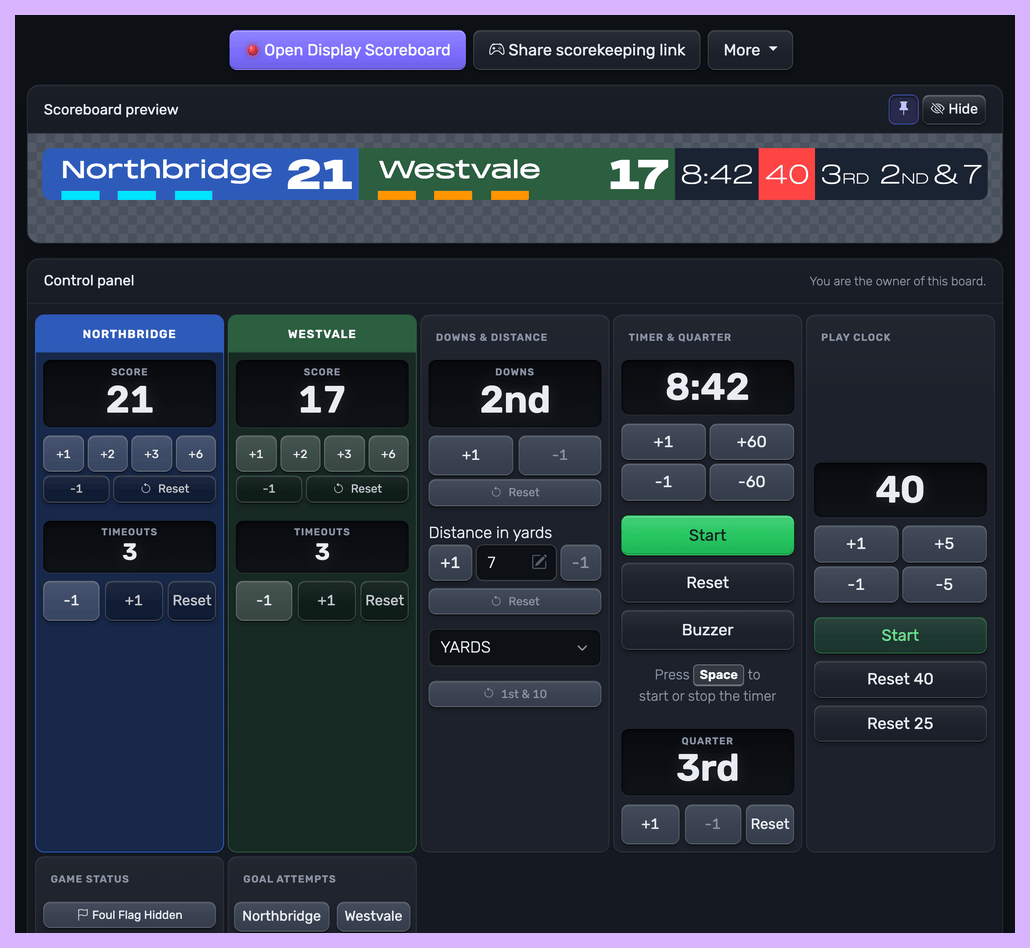
On our football scoreboard the game clock is a simple timer with a Start button. Under normal timing you're stopping and starting it constantly. Once the mercy rule is in effect you press Start and mostly leave it alone — stop it for a charged timeout, an injury, and a score if your state stops for scores, and that's the whole job.
Two things worth getting right before kickoff:
Leave the play clock on. No state we read switches it off, and Indiana, Louisiana and Utah say so in as many words. The mercy rule changes the game clock only.
Tell the press box. Several associations put this in writing because it goes wrong otherwise — Indiana makes the referee notify both head coaches and puts the home team in charge of telling the timing crew. If your scoreboard operator is a parent who volunteered twenty minutes ago, they will not know the rule changed unless somebody says so.
If you're streaming the game, our guide to putting a football scoreboard overlay into OBS covers the broadcast side, and one board drives the screen and the stream at the same time.
The sixteen we couldn't verify
We left a state out rather than guess at it. Arkansas, Delaware, Hawaii, Illinois, Maine, Massachusetts, Mississippi, Montana, Nevada, New Hampshire, North Dakota, Rhode Island, South Carolina, Vermont, Virginia and West Virginia aren't in the table yet, and neither is the rest of California beyond the Southern Section.
That's deliberate. Every one of those has a number floating around on aggregator sites, and we couldn't open the association's own document to confirm it — some associations block automated access, others publish the rule only in a members' packet. Repeating a number we hadn't checked would have made the table look complete and be wrong, which is worse than short.
Read your own state's rule
One more reason not to take any table, including this one, as gospel: these rules move.
Kentucky is the clean example. The KHSAA went from 45 points to 36 in February 2013, then from 36 to 35 in January 2024. That last change is pure football arithmetic: five touchdowns with extra points is 35, so under the old number a team a clear five scores ahead had to go for two to trigger the clock. At 35 it triggers on the fifth touchdown, which is what anyone watching would expect.
Which also means the PDF you find first might be stale. Kentucky's own website still hosts a running-clock memo that says 45 — thirteen years out of date — right alongside the page that says 35. We nearly used it.
Ten minutes with your association's current football bulletin beats any summary, and it settles the argument before it starts instead of during it.
Want the scoring side rather than the clock? We've written up how football scoring works and, for the seven-on-seven and 5v5 codes, flag football scoring separately.
Do you have feedback or questions? Please do comment below!

Written by Caspar von Wrede
Founder of KeepTheScore. Building tools that help teams track scores and celebrate wins.