Flag Football Scoring Rules Explained (2026)
Touchdowns, extra points and safeties in flag football — how the 5v5 and high school rulebooks differ, and how to set a scoreboard up for a flag game.
Article Contents
A touchdown is six points. Nobody argues about that one.
The extra point is where flag football gets messy, and the reason is worth knowing before your first game rather than during it: there is no single flag football rulebook. The 5v5 game has one answer, and high school flag has fifty, because each state association picks its own options. Get that wrong and you'll be relitigating a one-point conversion on the sideline in week one.

The scoring plays
There are only four ways to put points on the board, which is one of the nicer things about the sport.
A touchdown is 6 points. The ball carrier crosses the goal line, or catches it in the end zone. Same as tackle football.
The try — what everyone calls the extra point — is worth 1 or 2 depending on the distance you attempt it from. In the 5v5 game there's no kicking, so both are ordinary plays from scrimmage. Run it in or throw it in.
A safety is 2 points to the defending team, awarded when the ball carrier's flag is pulled in their own end zone.
An interception returned for a touchdown is 6. Picked off during a try and returned the other way, it's worth 2. That last one is the rule rec leagues forget exists until it decides a playoff game.
Where the rulebooks agree, and where they don't
Five yards for one point, ten yards for two, is the de facto standard. NFL FLAG uses it. So does the IFAF Fives rulebook — the 5v5 code that will be played for gold in Los Angeles in 2028. California's high school rules use it too.
| Ruleset | Players | 1-point try | 2-point try | Kicking |
|---|---|---|---|---|
| NFL FLAG (youth and rec) | 5v5 | 5-yard line | 10-yard line | None at all |
| IFAF / Olympic | 5v5 | 5-yard line | 10-yard line | None at all |
| NFHS high school | 7v7 | Set by your state | Set by your state | Only if your state adopts it |
That last row is not us dodging the question. The NFHS rulebook ships with a table of state association adoptions, and the try, the field size, the mercy rule and whether place kicking exists at all are all on it. Tennessee, for instance, allows no place kicking and runs its overtime tries from the 3-yard line rather than the 5.
If you're starting a league from scratch and nobody is forcing your hand, use the Olympic 5v5 rules. It's the version the sport is consolidating around, and within two years your players will have seen it on television.
The 5v5 game has no kicking. High school might.
This catches more people out than the try distance does.
In NFL FLAG and the Olympic game there is no kicking whatsoever. No field goals, no extra-point kicks, no kickoffs. A "punt" is a declared turnover — you hand the ball over and the other team starts at their own 5-yard line. Nobody's foot touches the ball.
High school flag is a different animal. It's 7v7, and field goals worth 3 points exist if — and only if — your state association has adopted kicking rules. Plenty haven't. From the 2026-27 season a safety also restarts with a scrimmage kick from the scoring team's own 20-yard line, which replaced the old rule where the other team snapped from the 30.
So "flag football has no kicking" is a half-truth. True for 5v5, an open question for high school.
First downs work differently
Flag football mostly doesn't use a 10-yard chain.
In the 5v5 game you get four downs to cross midfield. Cross it and you get a fresh set to score — three more under NFL FLAG, four under the Olympic rules. Miss it and you turn the ball over on the spot.
High school uses a "zone to gain" instead: you advance to the next 20- or 40-yard line rather than measuring ten yards from where you started. There is no chain gang, and there's nothing to measure.
The clock
NFL FLAG runs two halves of somewhere between 15 and 25 minutes, depending on the league. The clock runs continuously and stops only for injuries, halftime, and each team's one 60-second timeout per half.
High school is four 12-minute periods. Teams get three charged timeouts per half from 2026-27, up from two.
Mercy rules are another state decision, and they're usually implemented as a clock change rather than an early finish. Tennessee, again as an example, puts the game clock into continuous running mode if a team leads by 19 or more at the two-minute timeout of the fourth period. Note that's the flag number — Tennessee's tackle rule is a different one entirely. We've collected the tackle football mercy rule state by state if you need to compare.
A running clock sounds easier to operate than it is. You'll be asked "how long left?" about forty times a game, which is the entire argument for putting the clock on a screen everyone can see.
What flag operators actually switch off
We host around 21,000 football scoreboards that see real use, so rather than guess at how people set up for flag, we can look at which controls they turn off. All three of these are switched on by default, so switching them off is a deliberate choice by whoever built the board.
Roughly two in three switch off the play clock. About a third switch off the field-goal control. One in seven hides down and distance entirely.
That is the flag football setup, almost exactly: no play clock enforcement, no kicking game, and no reason to show a down counter in a league that doesn't use conventional first downs.
One honest caveat. We can't tell a flag board from a tackle board in that data — nobody has to declare which they're running, and some of those switched-off play clocks will be youth tackle leagues that don't enforce one either. Treat the pattern as a strong hint, not a measurement.
Setting up a scoreboard for a flag game
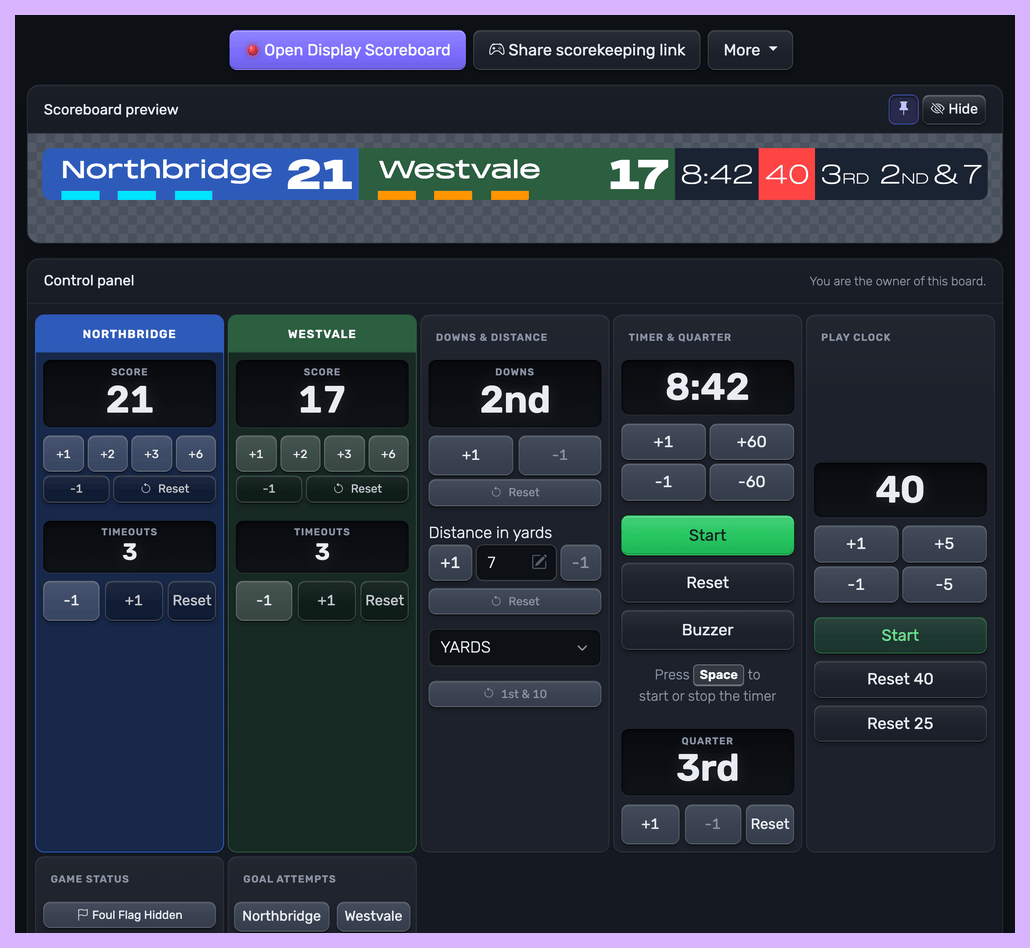
Our football scoreboard handles flag as-is, but three settings are worth changing before kickoff.
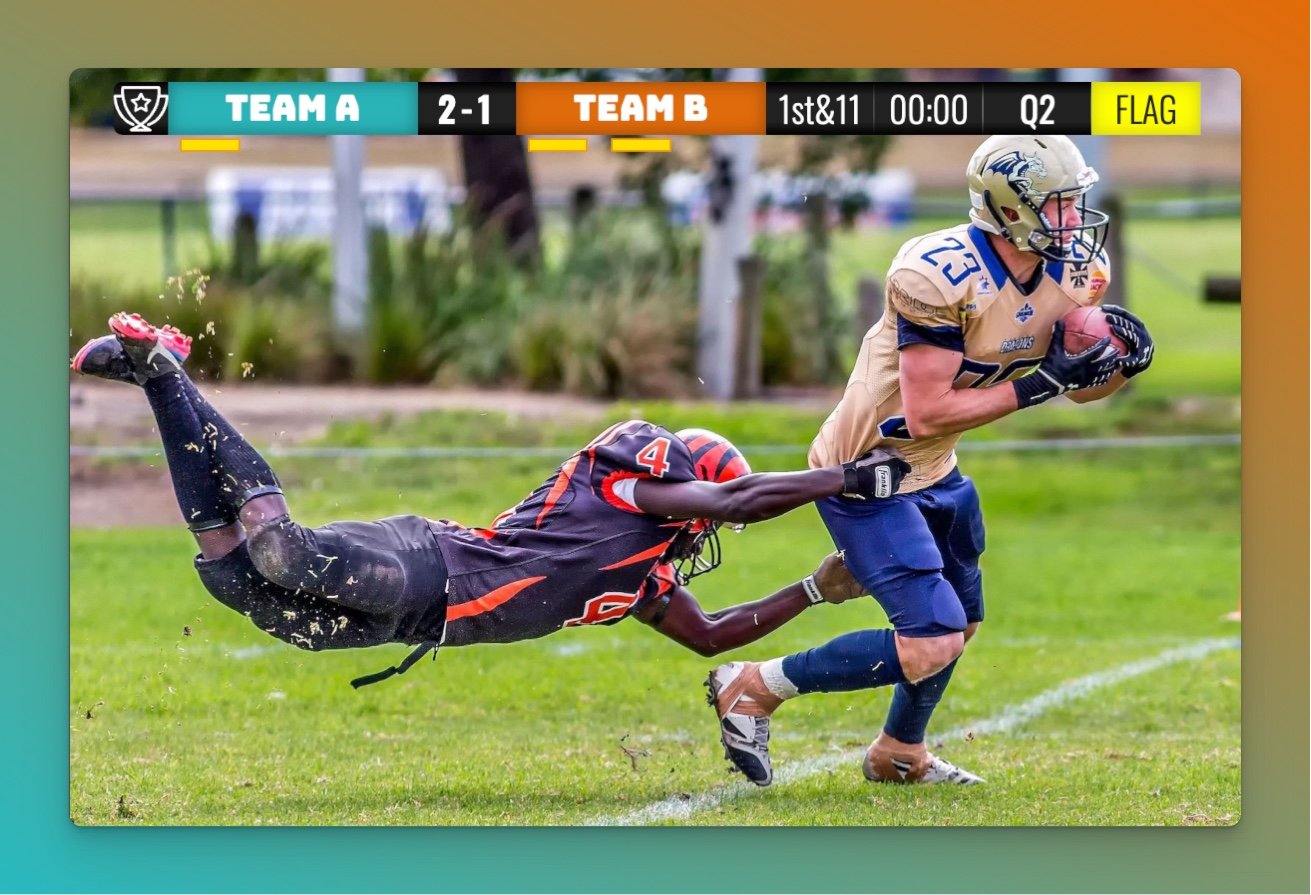
Turn the play clock off unless your league genuinely enforces one. Turn the goal attempt control off, since there's no field goal to signal in the 5v5 game. And if you're playing two halves rather than four quarters, hide the quarter indicator — it counts 1st, 2nd, HT, 3rd, 4th, which reads wrong for a two-half game. Run the clock and let the halves speak for themselves.
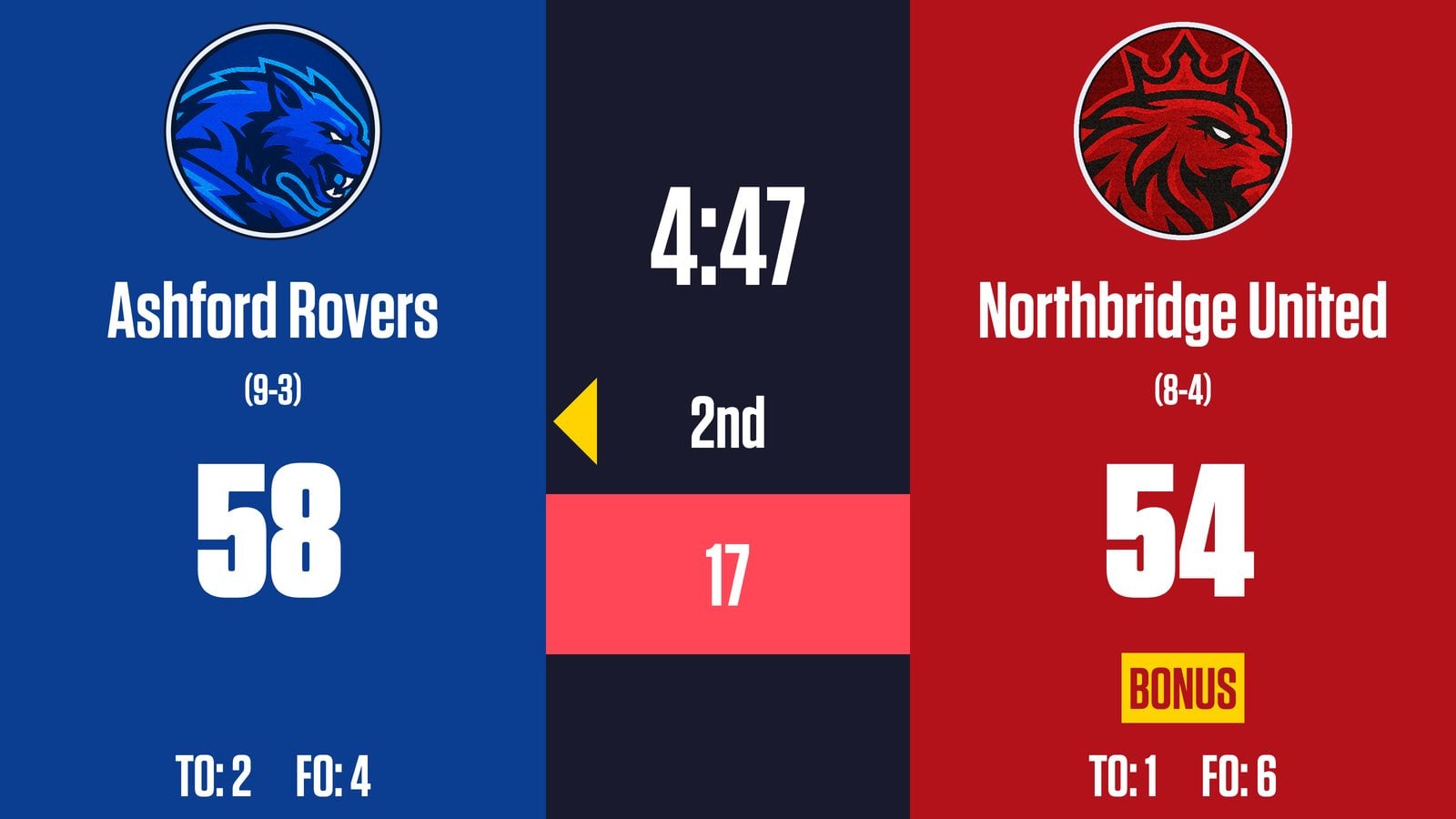
For scoring you'll use the +6, +1 and +2 buttons and never touch +3. The timer takes whatever duration you give it, so 20-minute halves are no problem.
High school 7v7 needs almost none of that. Four periods and a play clock both apply, so leave the defaults alone — though if your state uses zone-to-gain first downs, the distance field is more useful showing the yard line to reach than a number of yards.

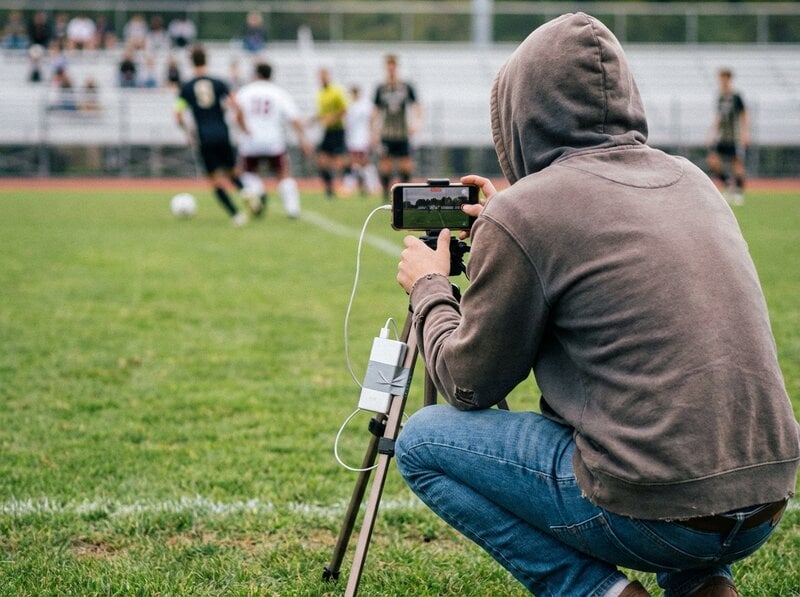
The board updates from a phone, which matters more here than in most sports. There's no press box at a park field. You're on the sideline in the wind, and the display is a laptop on a folding table or a phone leaning against a water jug.
Streaming the game? Our guide to adding a football scoreboard overlay to OBS covers the broadcast version, and one board drives both at once.
Read your own rulebook before week one
Girls' flag football is the fastest-growing high school sport in the country. Seventeen state associations have sanctioned it, six more voted during 2026, and Louisiana joins in 2027. Growth that fast is exactly why the rules haven't settled yet.
So take the table above as a map, not gospel. Ten minutes with your league's actual rulebook beats a fortnight of arguing about a one-point conversion.
Coming from the tackle game and want to compare? We've written up how scoring works in American football separately.
Do you have feedback or questions? Please do comment below!

Written by Caspar von Wrede
Founder of KeepTheScore. Building tools that help teams track scores and celebrate wins.