Digital Scoreboards: Hardware vs Software Buying Guide (2026)
What digital scoreboards cost in 2026: LED and video boards vs software on a screen you already own. Real prices, five-year totals, and which fits your venue.
Article Contents
If you've been pricing digital scoreboards for a school gym, club, or community venue, you've probably hit two very different worlds: a five-figure LED scoreboard quote from a vendor like Daktronics, and a $14/month web-based scoreboard that runs in a browser. Both get called "digital scoreboards." They are not the same thing.
This guide explains what each one actually is, what they cost over five years, and which approach fits which venue.
What people mean by "digital scoreboard"
"Digital scoreboard" is used two different ways, which is half the confusion in this category.
- A fixed digital display panel sold as a unit. These are LED or LCD panels with built-in scoreboard firmware, sold by vendors like Daktronics, Nevco, and Electro-Mech. They look "digital" because the numbers aren't physical bulbs, but they're still a piece of mounted hardware with a proprietary control console.
- A web-based / software scoreboard. Runs in a browser on a laptop, tablet, or phone. The display is whatever screen you plug in: a TV, a projector, or — yes — an LED wall over HDMI. KeepTheScore is this kind of product.
Most buying decisions come down to choosing between these two, so the rest of this guide compares them directly: LED hardware means a purpose-built scoreboard unit installed in a venue, and software means a digital scoreboard you run on screens you already own.
What digital scoreboards cost in 2026
Here's the market at a glance:
| Scoreboard type | Price range |
|---|---|
| Portable tabletop scoreboards | $200 – $1,000 |
| Basic LED scoreboards | $3,000 – $8,000 |
| Multi-sport LED scoreboards | $5,000 – $15,000 |
| Video scoreboards (small to medium) | $15,000 – $50,000 |
| Large video boards / jumbotrons | $50,000 – $150,000+ |
| Software on a screen you own | From $14/month |
For hardware, installation typically adds another $2,000 – $10,000 depending on electrical work, mounting complexity, and whether you need outdoor-rated equipment. Outdoor boards cost 50–100% more than indoor equivalents. For a full breakdown by venue size and brand, see the gym scoreboard cost guide.
The hardware options, briefly
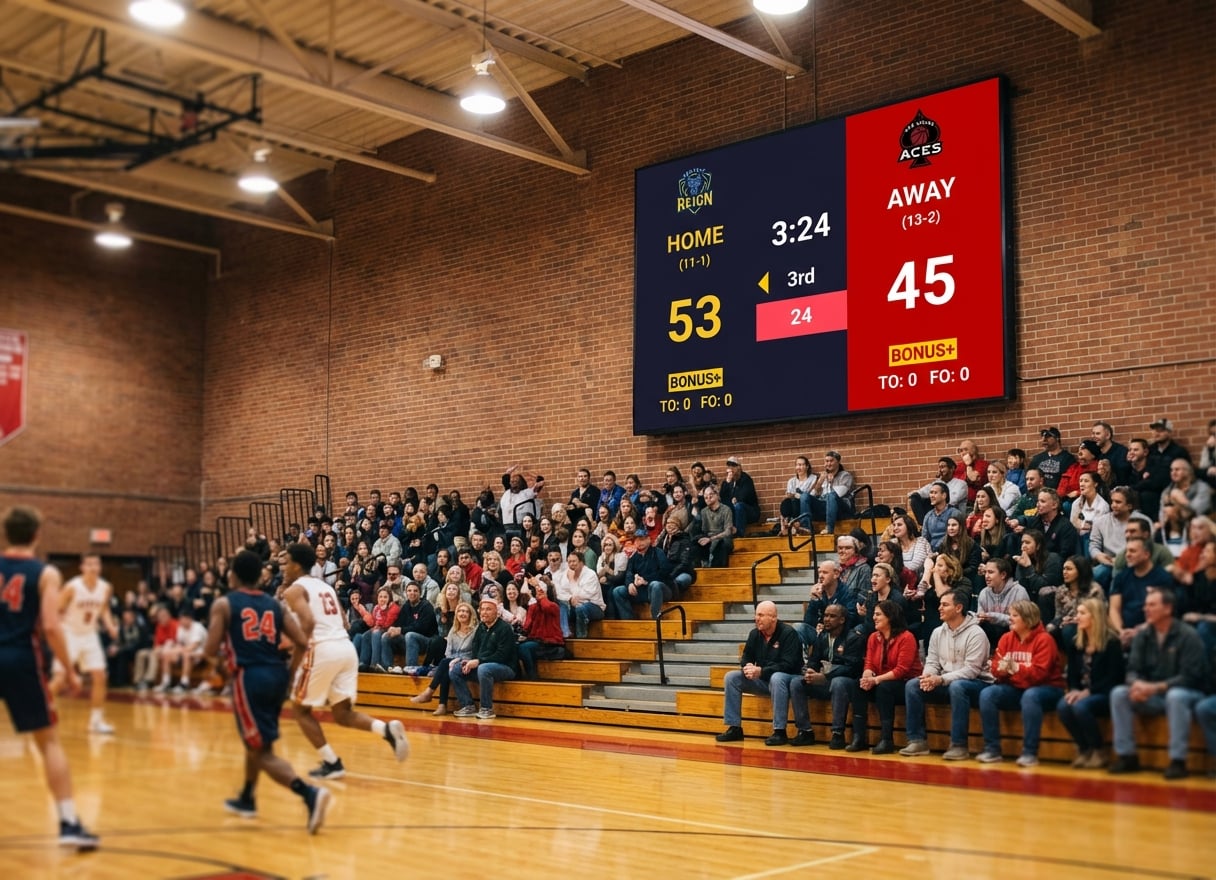
Basic LED segment scoreboards ($3,000–$8,000) show scores, a game clock, and period indicators in classic red digits — one sport, numbers only. Multi-sport LED boards ($5,000–$15,000) add configurable layouts, team names, and shot clocks for a gym that runs basketball, volleyball, and wrestling off the same wall. Video scoreboards ($15,000 and up, sharply) are high-resolution LED panels that display graphics, replays, and sponsor videos — this is where booster-club budgets go to die. Portable tabletop units ($200–$1,000) are battery-powered score displays readable from 30–50 feet, fine as a backup or for small courts.
On brands: Daktronics is the premium industry leader, Nevco and Fair-Play occupy the mid-range, and ScoreVision sells scoreboard software (an annual subscription from $1,250) that runs on an Apple TV plugged into any display. None of the hardware vendors publish prices: Daktronics says price depends on display size, pixel pitch, installation and control system. If you're already holding one of their quotes, our Daktronics and ScoreVision alternatives guide breaks down the trade-offs.
 Daktronics, the largest LED scoreboard maker, sells to schools on a quote-only basis.
The software option: a digital scoreboard on a screen you already own
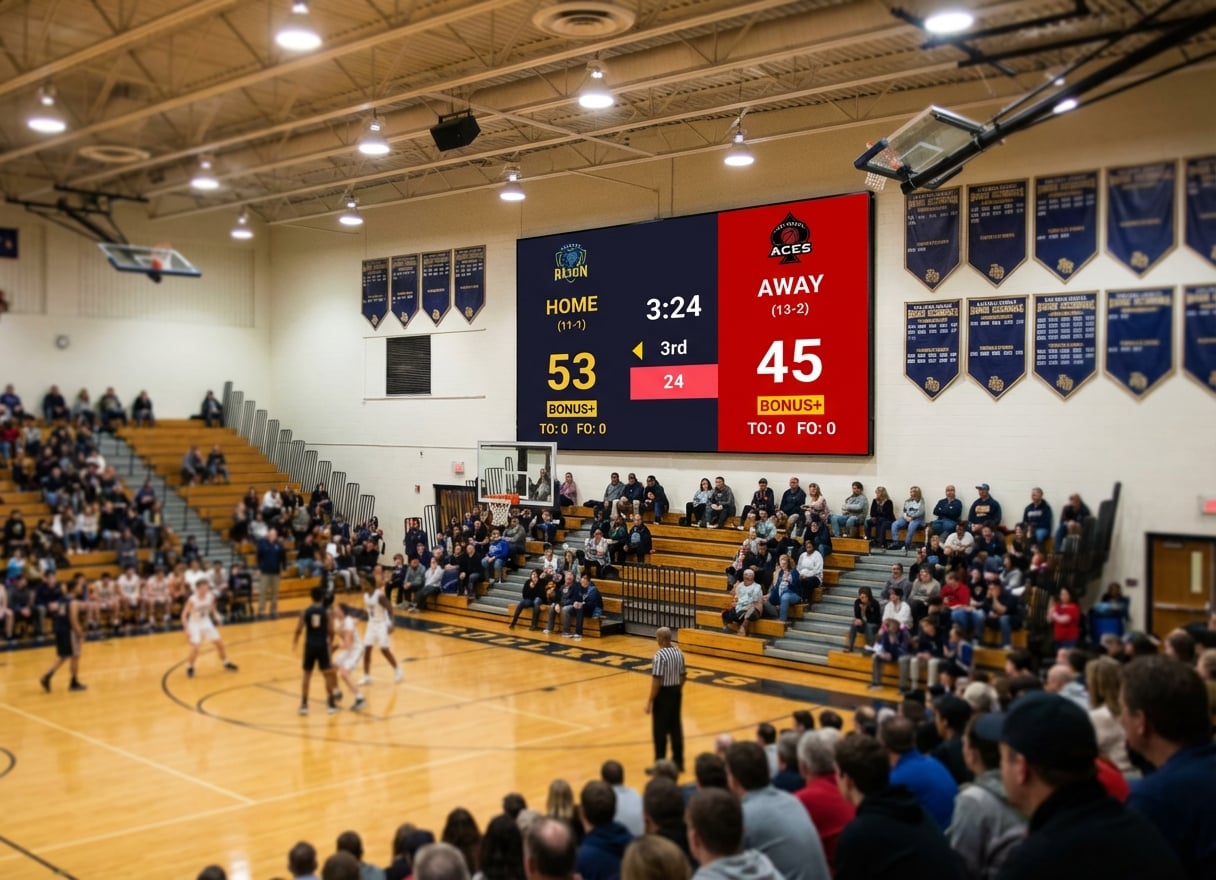
An LED scoreboard is a physical thing bolted to your wall. A software digital scoreboard is a web page: you create a scoreboard in the browser, open its display link full-screen on any TV, projector, monitor, or LED wall, and control it live from a phone or laptop anywhere in the venue.
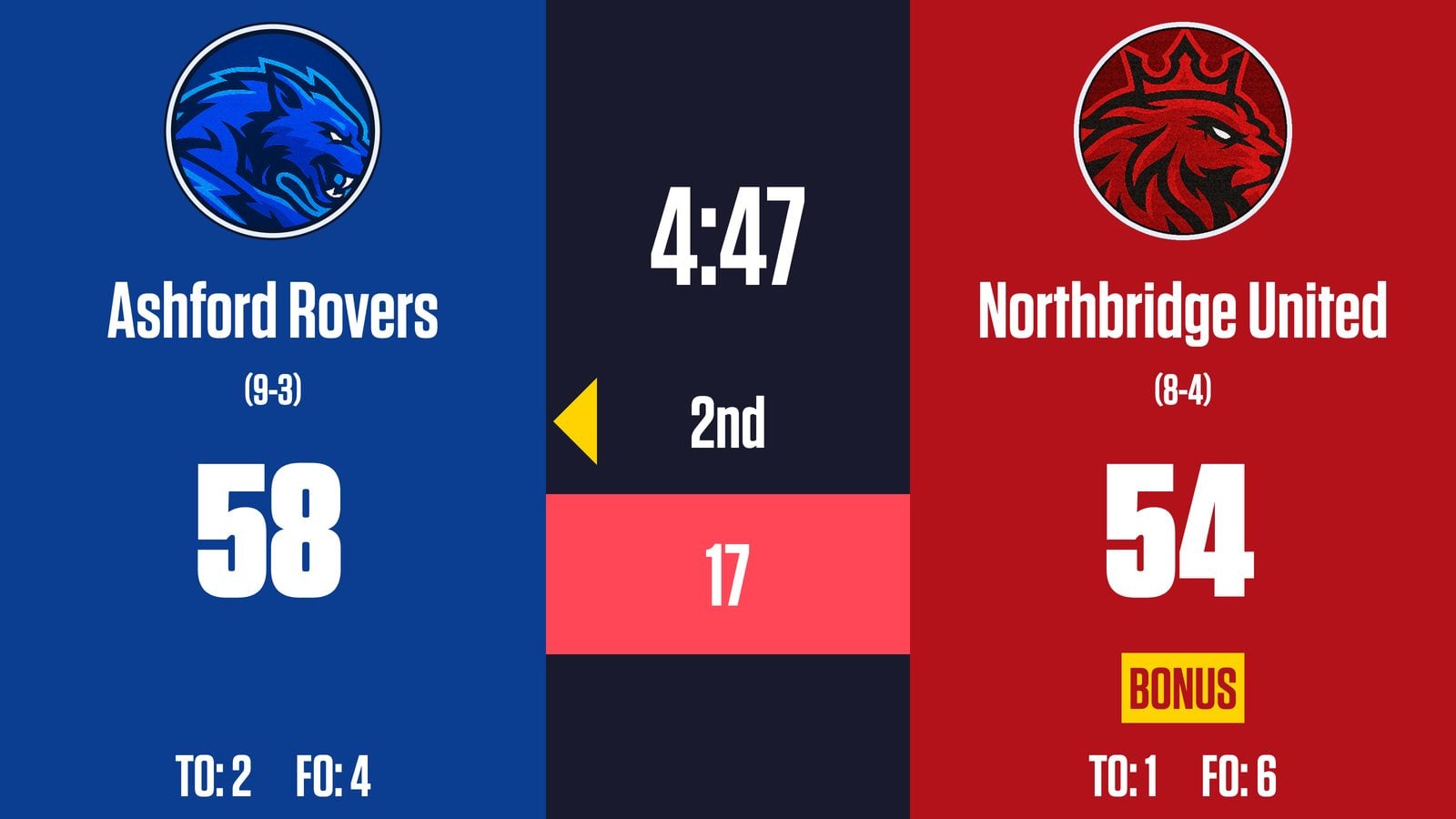 A browser-based digital scoreboard (KeepTheScore). The display is any screen with an HDMI input or a browser.
Setting one up takes about 30 seconds:
- Click the "Create a Scoreboard" button below and pick your sport.
- Enter the team names.
- Click "Open Display Scoreboard" on the screen that should show it.
- Keep the control view open on your phone or laptop and score the game.
It works for basketball, football, volleyball, hockey, tennis, wrestling, Gaelic games and more (15+ sports in total), includes game and shot clocks, team logos and custom branding, and doubles as a streaming overlay in OBS or vMix.
If your venue already has an LED video wall, that's the ideal display for it: any wall with HDMI input behaves like a giant monitor. The LED scoreboard software page covers that setup — controllers, resolutions, and the HDMI chain — in detail.
Software vs LED hardware, point by point
Cost
The single biggest difference, and the reason most schools end up looking at alternatives.
| Software (web-based) | LED hardware | |
|---|---|---|
| Scoreboard hardware | $0 — runs on a laptop, tablet, or phone you already own | $8,000 – $50,000+ |
| Display | You supply it: an existing gym TV, projector, or LED wall — or $400 – $3,000 for a new TV if you don't have one | Included |
| Software / subscription | Free tier, or from $14/mo | Often bundled, occasionally extra |
| Installation | None | $2,000 – $10,000 (electrician, mounting, structural) |
| Replacement panels / bulbs | n/a | $500 – $3,000 per failure |
| Five-year total (typical mid-size gym) | ~$1,200 – $4,000 (incl. one new TV if needed) | $15,000 – $60,000+ |
The honest caveat on the software side: the scoreboard itself is free or cheap, but you still need some display to show it on. The savings come from the fact that most schools and clubs already have a TV or projector in the gym — and even buying one from scratch costs a fraction of an LED scoreboard.
Two things drive the LED number up: the display is custom-fabricated hardware, and installation requires power runs, structural mounting, and often a network drop. None of that is recoverable if you ever move or rebuild the venue.
Setup time
- Software: under a minute. Open the site, pick a sport, share the display URL. If you want it on a TV in the gym, plug a laptop in via HDMI.
- LED: weeks to months. Vendor quote, board fabrication lead time (often 6–12 weeks), site survey, electrician, install crew, network configuration, vendor training session.
If your season starts in three weeks, this matters.
Maintenance and failure modes
LED scoreboards have parts that fail: individual LEDs burn out, control consoles develop dead keys, the wireless link between the keypad and the board drifts. Schools we talk to often have a "the 4 in the away score doesn't work" situation that's been waiting on a service call for two seasons.
Software scoreboards inherit the failure profile of the devices running them. A laptop dies — swap it for any other laptop. The display TV dies — swap it for any other TV. Nothing is custom and nothing is one-of-a-kind.
Flexibility
This is where the gap is widest.
An LED scoreboard does one sport — the one it was built for. A basketball board can't run a volleyball match. A football board can't run a wrestling meet. Multi-sport venues end up buying multiple boards or a single board with a clunky "sport switch" that still locks the display layout.
A software scoreboard is just software. KeepTheScore alone supports 15+ sports natively, plus generic scoreboards for events that don't map to a standard sport, and its sister site Leaderboarded runs online leaderboards for rankings. You change sport from a dropdown. Team logos are a PNG upload rather than a vendor-installed upgrade, sponsor logos rotate without a service call, and the same scoreboard URL becomes a browser-source overlay in OBS, vMix, or Streamlabs — an LED board can't appear in your stream without a camera pointed at it.
Portability
A software scoreboard goes wherever the laptop goes. Away games, tournaments at neutral venues, summer camps in a different gym — the same setup works. An LED scoreboard stays bolted to the wall it was installed on.
Which one fits your venue
When software is the right call
- A school gym, sports hall, or club without a five-figure capital budget
- A multi-sport venue that runs basketball, volleyball, and a half-dozen other sports off the same court
- Anyone livestreaming games — the scoreboard belongs in the overlay, not on a wall behind the camera
- A youth league or community organisation that travels between venues
- A venue that already has a TV, projector, or LED video wall and just needs software to drive it
When LED hardware is still the right call
- An outdoor stadium where viewing distances exceed what a TV or projector can do
- A high-profile college or professional venue where the scoreboard is part of the brand identity
- A venue with no power for laptops near the playing surface and existing LED infrastructure
- Running events where a single dedicated operator at a fixed keypad is genuinely faster than tablet-based control
Most schools and clubs we talk to discover they're in the first category by accident — they assumed LED was the standard because that's what they remembered from their own school, and they hadn't realised the same gym TV they bought for assemblies could double as a scoreboard.
What our users say
"Wow guys, what a great app! I'm using it to stream my son's rugby games in South Africa!" — Lance
"Keepthescore.com transformed our school tournaments. It's so easy to use, and the kids love seeing the scores on the big screen!" — Sarah, PE Teacher
Try a digital scoreboard right now
You don't need to commit to anything. Open a scoreboard, plug a laptop into your gym TV with HDMI, and run one game with it. You'll know within a half whether the workflow fits — and only then decide whether a hardware quote is still worth signing.
Free plan, no credit card, no install. For a step-by-step display setup, see how to display a live scoreboard on a TV or projector; for turning any computer into the scorekeeper's station, see PC scoreboards.
Digital Scoreboard FAQs
"How much does a digital scoreboard cost?"
Hardware digital scoreboards run from $200–$1,000 for portable tabletop units, $3,000–$8,000 for basic LED boards, $5,000–$15,000 for multi-sport models, and $15,000–$150,000+ for video scoreboards — plus $2,000–$10,000 for installation. Software digital scoreboards cost a small monthly subscription and use a TV, projector, or LED wall you already own. See our pricing page for current plans.
"Is a digital scoreboard bright enough for a gym?"
Yes, when you pair it with the right display. A 65"–85" TV or a daylight-grade projector handles a standard high-school gym from any spectator seat. The scoreboard software doesn't change brightness — that's a property of the screen you plug it into, the same way it would be for any other content.
"Can I run a digital scoreboard on my existing LED video wall?"
Yes. Any LED video wall with an HDMI input behaves like a giant external monitor. Plug a laptop in, open the scoreboard's display URL in a full-screen browser, and it shows on the wall. This is the most common upgrade path for schools that already invested in an LED wall for assemblies. Our LED scoreboard software page covers the setup in detail.
"Do I need special equipment to use scoreboard software?"
No. You need a device to control the scoreboard (any phone, tablet, or laptop) and a screen to display it (any TV, projector, monitor, or LED wall with internet access or an HDMI-connected computer). Nothing is installed and nothing is proprietary.
"Do I need to buy separate scoreboards for each sport?"
With hardware, usually yes — a basketball board can't run a volleyball match, which is what pushes most multi-sport venues toward software. With KeepTheScore, a single account covers every sport; you pick the sport when you create the board.
"What happens if the internet goes out mid-game?"
Web-based scoreboards keep displaying the last state and sync score updates when the connection comes back. For most school gyms this never matters, but a mobile hotspot off any phone is a fine fallback if the building's wifi is unreliable.
"How does a digital scoreboard look on a livestream?"
The same display URL works as a browser source in OBS, Streamlabs, vMix, and any other software with a browser input. The scoreboard sits on top of your camera feed at whatever size you want — there's no separate streaming version. An LED scoreboard, by contrast, can only appear in your stream if a camera is pointed at it.
"What about the shot clock, play clock, and period horn?"
KeepTheScore includes shot clocks for basketball, play clocks for football, and period timers across every timed sport. The horn plays through whatever speaker your laptop is plugged into — a portable bluetooth speaker on the scorer's table is the usual setup. See the TV scoreboard setup guide for display and audio tips.

Written by Caspar von Wrede
Founder of KeepTheScore. Building tools that help teams track scores and celebrate wins.