How does basketball scoring work?
A complete guide to basketball scoring: field goals, free throws, three-pointers, and special situations like and-ones and four-point plays.
Article Contents
Basketball scoring isn't complicated once you've broken it down. The basketball goes through the hoop. Depending on where you shot from, it's worth one, two, or three points. That's basically the whole basketball scoring system — but the situations around it (and-ones, bonus shots, four-point plays) are where casual basketball fans get tripped up.
James Naismith invented basketball in 1891 as a way to keep his students moving through a brutal Massachusetts winter. The basketball scoring system as we know it showed up five years later, in 1896, when rules split shots into field goals (made during play) and free throws (awarded after fouls). Those two categories still anchor everything in basketball today.

The Three Ways to Score Points
Three ways to score, and only three. Each has its own value and its own rule. Once you've got the difference between them straight, every other scoring situation is a combination of these.
Field Goals: Two Points or Three
Field goals are baskets made during live play — everything except free throws. The point value comes down to one thing: where the shooter's feet were when the ball left their hands.
Two-Point Field Goals
- Any shot taken inside the three-point arc
- Worth 2 points, no matter how nasty or easy it was
- Layups, dunks, mid-range pull-ups, post moves — all 2
- Most common scoring method in basketball, by a wide margin
Three-Point Field Goals
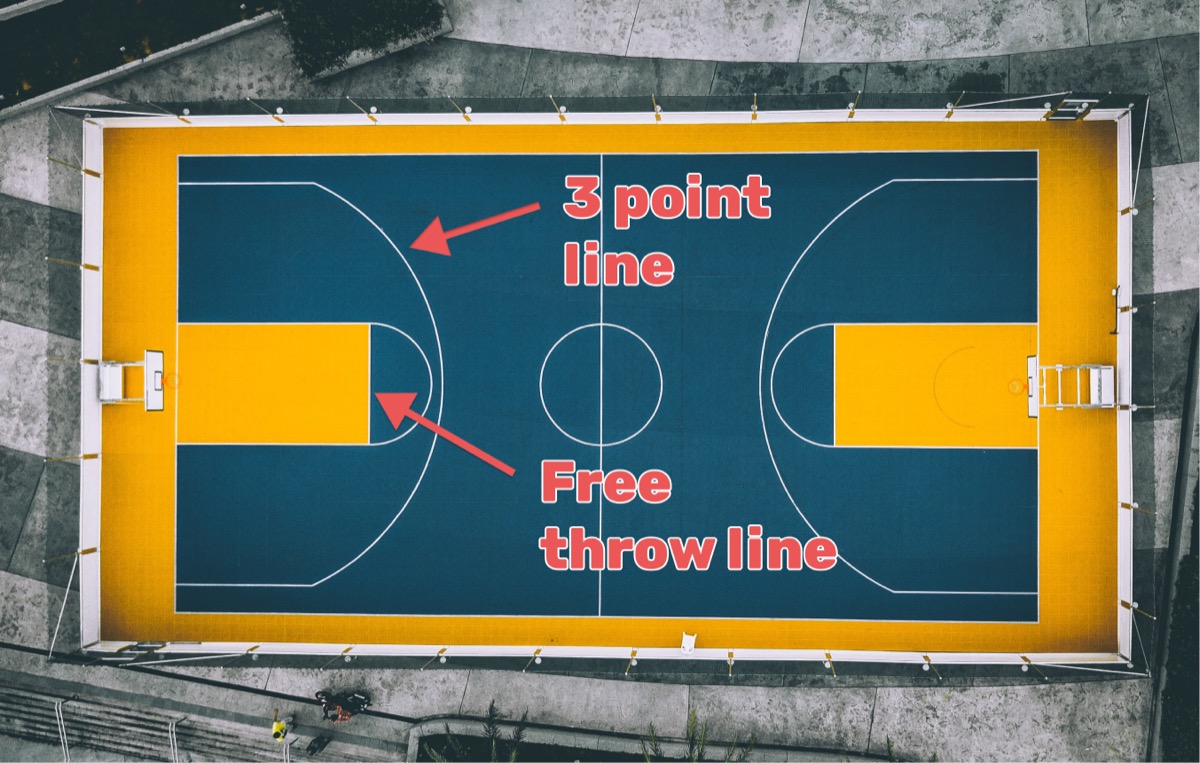
- Both feet have to be behind the three-point line at release for the three-point field goal to count
- Worth 3 points, because three-point shots are harder
- Foot on the three-point line? It's a 2, not a 3 — that detail decides a lot of basketball games
- The three-point line itself isn't a fixed distance: NBA goes 23'9" (22' in the corners), high school sits at 19'9"
Common field goal techniques in basketball:
- Layups — close-range running field goals, usually off the backboard. Highest percentage shot in basketball.
- Jump shots — shoot on the way up, get separation from the defender, shoot over them.
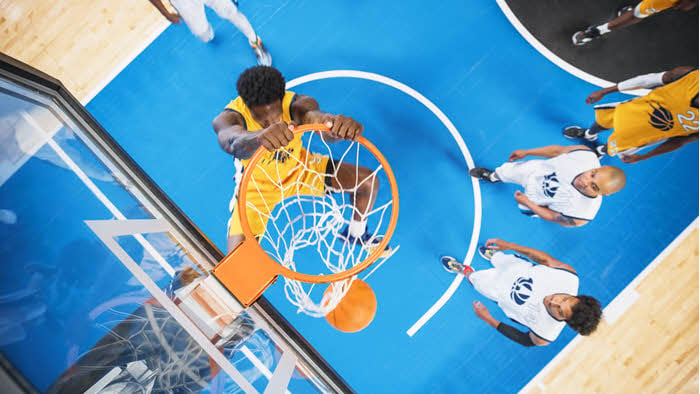
- Dunks — throw the basketball through from above. If it goes in, it's 2 points and a momentum shift.
Free Throws: One Point Each
Free throws are uncontested shots that come after certain fouls or violations. Each one's worth a point.
When Free Throws Are Awarded:
- Shooting fouls — fouled while attempting a field goal
- Bonus situations — opposing team has racked up too many team fouls in the period
- Technical fouls — unsportsmanlike conduct or procedural issues
- Flagrant fouls — excessive or dangerous contact
Free Throw Rules and Procedures:
- Taken from the free-throw line, exactly 15 feet from the basket
- 10 seconds to release after the ref hands you the ball
- Shooter can't cross the line until the ball hits the rim
- Other players stay outside the lane until the release
- No defensive pressure allowed
The NBA keeps an extensive list of fouls. The ones that send a player to the line most often:
- Personal fouls — illegal physical contact
- Six players on the court at once (technical territory)
- Hanging on the rim, net, or backboard during play
- Reaching in or holding
- Blocking — getting in the way of an offensive player illegally
Special Situations and Combinations
A few scenarios bend the rules and combine field goals and free throws:
Bonus Free Throws
When a team racks up too many fouls in a period, the other team enters the "bonus":
- NBA: 4 team fouls per quarter → 2 free throws on every non-shooting foul after that
- NCAA: 7 team fouls per half → "one-and-one" (make the first to earn the second)
- FIBA/International: 4 team fouls per quarter, NBA-style
"And-One" Plays
The and-one is one of the best plays in basketball. A player gets fouled during the shot, the shot goes in anyway, and they get a free throw on top:
- Basket counts at its normal value (2 or 3)
- Fouled player gets one bonus free throw
- Make it and you've got a 3-point or 4-point play
- Crowds erupt, benches erupt, momentum swings — these are the moments
Four-Point Plays
Rare and loud. A player makes a three-point field goal with contact, draws the foul, hits the free throw. Only possible since the NBA introduced the three-point line in 1979.
Tracking Points on the Scoreboard
Every point hits the scoreboard the moment it happens, alongside game time, fouls, and the rest. A lot of arenas use different sounds or lights for twos and threes, which helps players, coaches, and the crowd track scoring at a glance. For the full breakdown of every number you see during a game, we wrote how to read a basketball scoreboard.

What Community Basketball Scoring Actually Looks Like
NBA box scores get the coverage, but most people watching basketball aren't watching the NBA. They're watching their kid's middle school basketball team, a rec-league semifinal, or a high school basketball playoff. We see a lot of those games because parents, coaches, and tournament organizers run our scoreboard on tens of thousands of community basketball games every season.
Numbers below are pulled from 5,900 completed basketball games scored on KeepTheScore — boards using the basketball scoreboard layout, filtered to games marked final with both teams above zero and a credible total between 20 and 350 points. The slice covers active boards from mid-2024 through May 2026.
- Average final: 92–78, total 170 points. About three-quarters of an NBA total. Half-game formats and full-length high-school games are mixed together; only 38% of games cross 200 points total.
- Median margin: 6 points. Roughly 37% of games are decided by 3 or less. Community basketball is closer than the pros, but the average margin is 14 — that's pulled up by a long tail of mismatched scrimmages and one-sided youth blowouts. Median is the honest number. Half of all games finish within two possessions.
- 13% of games end in a blowout (30+ margin). Common enough that anyone broadcasting community basketball needs a plan for them. The rest of the time, the score still matters in the final minutes.
A couple of caveats. We don't separate two-period (halves) and four-period (quarters) boards in the average — operators run both formats — so the 170 is a blend across all real-game lengths. We also don't publish an overtime rate because the OT flag is inconsistent in the wild (operators don't always flip it), and we'd rather leave a stat out than ship one we can't defend.
If you operate a scoreboard for community games, these are the numbers your audience is used to seeing. A board that runs 92–78 with a 6-point margin tracks intuitively for parents; a board displaying 130–60 will get a second look.
Test Your Basketball Scoring Knowledge
Run through these and see how the rules land in practice:
Scenario 1: Basic Field Goal
A player takes a jump shot from 18 feet, well inside the three-point line. The ball drops through cleanly.
Question: How many points does the team score?
Scenario 2: Free Throw Situation
A player is fouled while dribbling (not shooting) and is awarded free throws because the opposing team is in the bonus. They make both free throw attempts.
Question: How many points does the player's team earn?
Scenario 3: Bonus Situation
During an NCAA game, Team A commits their seventh team foul in the first half. Team B's player is fouled while passing (not shooting).
Question: What happens next?
Scenario 4: And-One Play
A player drives to the basket, makes a layup while being fouled hard by a defender. The referee calls the foul and counts the basket. The player then makes the bonus free throw.
Question: What is the total number of points scored on this play?
Practical Applications and Next Steps
The 1-2-3 system isn't just academic. It shapes every decision on the court:
- Coaching youth basketball — teaching when a shot's worth attempting vs. passing
- Playing competitively — knowing when to take the open three vs. driving for a higher-percentage two
- Watching games — seeing why a team fouls on purpose, or why they sprint for a "2-for-1" at the end of a quarter
- Operating scoreboards — getting points and bonus situations right in real time
Basketball's scoring system looks busier than it is. Three point values, a few special situations, and a logical thread tying them together. Once you've internalized the basketball scoring math, the strategy stops feeling like noise.
Looking to track scores for your own games? Check out KeepTheScore's basketball scoreboard for an easy-to-use digital solution that handles all the scoring complexity for you.
Pro Tip: If you're running a league or streaming multiple games, use Team Management to save team configurations (colors, logos, names) and reuse them instantly for future games.

Written by Caspar von Wrede
Founder of KeepTheScore. Building tools that help teams track scores and celebrate wins.