How does rugby scoring work?
Rugby scoring explained: try, conversion, penalty and drop goal values in union and league, the penalty try, bonus points, and how the two codes differ.
Article Contents
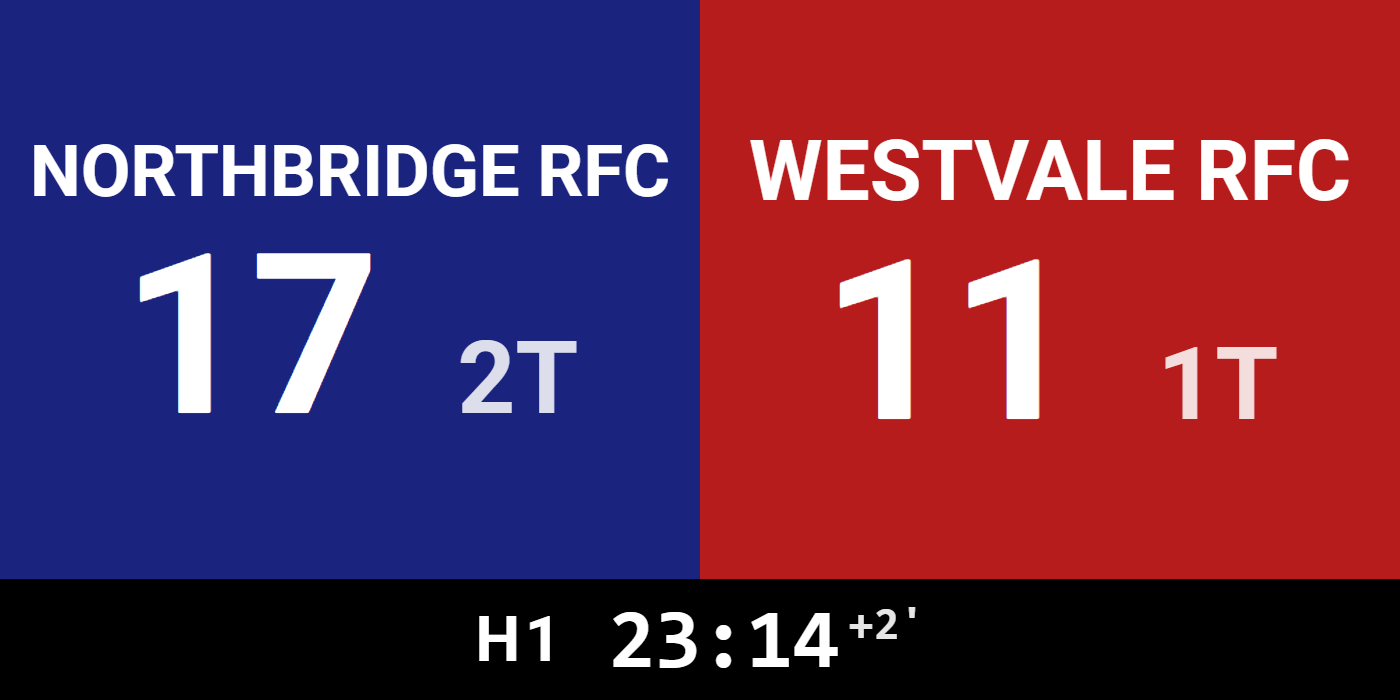
Rugby's two main codes — union and league — share four routine ways to score: a try, a conversion, a penalty goal, and a drop goal (and both also provide for a penalty try). What trips people up is that the two codes put different numbers on those plays, so a try is worth 5 in one and 4 in the other. This guide lays out every value in both codes, explains the penalty try, and shows how to read a rugby scoreline.
The four ways to score
Both codes share the same four routine scoring plays — the penalty try is a special case, covered in its own section below. Here is what each one is:
- Try — grounding the ball over the opponent's try line, in the in-goal area. This is the main event in both codes: 5 points in union, 4 in league. ("Try" is a historical name — it originally scored nothing and only earned a try at goal, the kick that followed.)
- Conversion — the kick at goal awarded after a try, taken in line with where the ball was grounded. Worth 2 points in both codes. Miss it and the try stands on its own; slot it and a converted try is worth 7 in union, 6 in league.
- Penalty goal — a kick at goal taken after the opposition concedes a penalty, normally a place kick. Worth 3 points in union, 2 in league.
- Drop goal — the ball is dropped from the hand and kicked over the bar off the bounce, in open play. Worth 3 points in union, and 1 point in league, where it is commonly called a field goal (especially in the NRL and Australian league).
That is the whole vocabulary. The posts are the same H-shape in both codes: kick it over the bar and between the uprights and it counts.
Union vs league: the values side by side
The two codes split in 1895 and have drifted apart ever since. The scoring is the clearest place you see it:
| Scoring play | Rugby Union | Rugby League |
|---|---|---|
| Try | 5 | 4 |
| Conversion | 2 | 2 |
| Penalty goal | 3 | 2 |
| Drop goal / field goal | 3 | 1 |
| Penalty try | 7 (no kick) | 4 + conversion |
The pattern: union rewards the kick, league rewards the try. A union side can build a score on penalties alone — three penalty goals (9 points) beats an unconverted try plus a drop goal (5 + 3 = 8). In league, the try does almost all the work: a drop goal is worth a single point, so it is a tie-breaker rather than a scoring plan.
A little history explains the odd numbers. The try originally carried no points of its own; it was assigned 3 points in 1894, raised to 4 in 1971, then to 5 in 1992 — each increase rewarding attacking play and making draws less likely. The values are not arbitrary; each code is nudging teams toward the game it wants to see.
The penalty try
A penalty try is awarded when the referee judges that a try would probably have been scored but for foul play by the defending team — a deliberate knock-on under the posts, a collapsed maul over the line, that kind of thing.
- In union, a penalty try is worth a flat 7 points, with no conversion attempted. Since a 2017 law change the referee simply awards the seven: it saves the kick, removes any doubt, and is a stiffer deterrent than the old "5 points plus a kick from in front."
- In league, a penalty try counts as a normal 4-point try, awarded between the posts. The team then takes a 2-point conversion from directly in front, so the sequence usually produces 6 points — but the conversion is a separate kick, not automatic.
Union's penalty try is an automatic seven points — the biggest single award in that code. League can go higher in one situation: if a defender fouls the try-scorer as well, the attacking side adds a penalty goal after the conversion, the so-called "eight-point try" (4 + 2 + 2). Both are reserved for clear-cut cases.
Reading a rugby score
Rugby uses a plain running total — no goals-and-points notation like Gaelic football, no innings like cricket. Knowing the values simply lets you see how a score was built.
Say a union side scores two converted tries, a penalty, and a drop goal: that is 7 + 7 + 3 + 3 = 20 points. The same four plays in league — two converted tries (6 + 6), a penalty (2), a field goal (1) — total 15, because every value except the conversion is lower.
Two shortcuts make a live score easy to follow:
- A converted try is 7 in union, 6 in league — the number you will add most often.
- In union, any score of 3 is interchangeable (penalty or drop goal), so "three more points" does not always tell you how they came.
Bonus points: how the league table works
Scoring does not stop at the final whistle. Most union competitions — the Six Nations, the club leagues, World Cup pools — award league (table) points on top of the match result, and this is where a lot of "rugby points system" confusion comes from:
- 4 points for a win, 2 for a draw, 0 for a loss.
- 1 bonus point for scoring a set number of tries (usually four).
- 1 bonus point for losing by 7 points or fewer — a reward for a close, competitive defeat.
So a team can lose a match and still take up to two table points home (one for four tries, one for a narrow defeat), or win and bank five. Exact thresholds vary by competition — the Six Nations, for instance, adds 3 table points for a Grand Slam — so always check the tournament's own rules.
Rugby league table points are simpler: traditionally 2 for a win, 1 for a draw, 0 for a loss, with no try bonuses. Some competitions now settle drawn matches in regular time with golden point extra time instead.
Modern wrinkles and other formats
A few variations are worth knowing:
- The two-point field goal. In 2021 the NRL made a drop goal from beyond 40 metres worth two points instead of one, to give trailing teams a late lever. Super League considered the same change and rejected it, so a British league drop goal is still worth a single point.
- Rugby sevens uses the exact same point values as fifteen-a-side union — try 5, conversion 2, and so on. The one scoring quirk: every conversion must be drop-kicked, and taken within 30 seconds. Drop-kicked conversions are legal in the fifteen-a-side game too; they are just rarely used there.
- Golden point and extra time. Knockout matches that cannot end level go to extra time; league's golden point ends the instant anyone scores — including a one-point field goal, which is exactly why those single points matter so much in a tight finish.
Quick reference: rugby scoring essentials
Rugby Union
- Try — 5 points
- Conversion — 2 points (converted try = 7)
- Penalty goal — 3 points
- Drop goal — 3 points
- Penalty try — 7 points, no kick
Rugby League
- Try — 4 points
- Conversion — 2 points (converted try = 6)
- Penalty goal — 2 points
- Field goal (drop goal) — 1 point (2 in the NRL from beyond 40m)
- Penalty try — a 4-point try between the posts, then a conversion attempt (usually 6)
The one-line difference
Union rewards the boot (a bigger try, 3-point penalties and drop goals); league rewards the try line (1-point drop goals, 2-point penalties).
How rugby scoreboards display it
A scoreboard has to get these values right automatically — nobody wants to be adding 5s and 3s in their head during a match. KeepTheScore has a dedicated board for each code: the rugby union scoreboard, with try 5 / conversion 2 / penalty 3 / drop goal 3, and the rugby league scoreboard, with try 4 / conversion 2 / penalty 2 / field goal 1. Pick your code and the buttons do the arithmetic.

Each board gives the scorekeeper one tap per scoring play, a count-up match clock with stoppage time, and half-time and full-time phases — running pitch-side on a phone, on a clubhouse TV or LED panel, or as an OBS overlay for a streamed game.
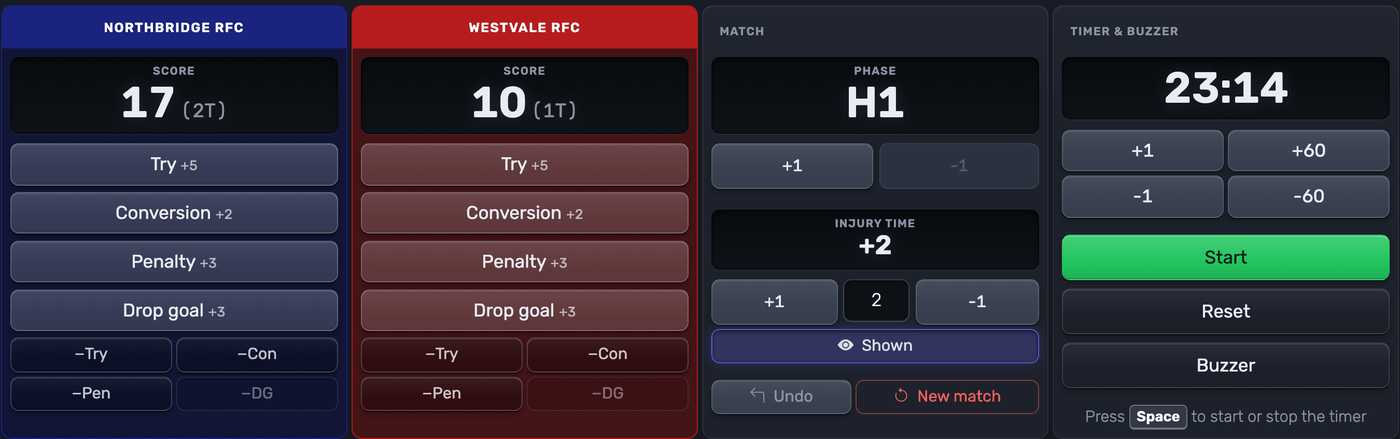
It is free to use with no signup, and a paid plan adds club branding, custom colours and ad-free displays. Pick your code and start scoring:
Rugby scoring FAQs
"How many points is a try in rugby?"
A try is worth 5 points in rugby union and 4 points in rugby league. A successful conversion afterwards adds 2 more in both codes, so a converted try is 7 in union and 6 in league.
"How many points is a conversion, penalty and drop goal?"
A conversion is 2 points in both codes. A penalty goal is 3 in union and 2 in league. A drop goal is 3 in union and 1 in league (often called a field goal in Australian league), though the NRL awards 2 for one struck from beyond 40 metres.
"What is a penalty try worth?"
In rugby union a penalty try is a flat 7 points with no conversion taken (a 2017 law change). In rugby league it's a 4-point try awarded between the posts, followed by a separate 2-point conversion attempt — usually 6 in all, but the conversion is not automatic.
"What is the difference between rugby union and rugby league scoring?"
Union rewards kicking and the try more heavily: try 5, penalty goal and drop goal 3 each. League rewards the try line: try 4, penalty goal 2, and a drop goal worth just 1. Conversions are 2 in both codes.

Written by Caspar von Wrede
Founder of KeepTheScore. Building tools that help teams track scores and celebrate wins.