How does Gaelic football scoring work?
Gaelic football scoring explained: goals, points, the two-pointer and the orange flag, how to read a scoreline like 2-10 (16), and how hurling differs.
Article Contents
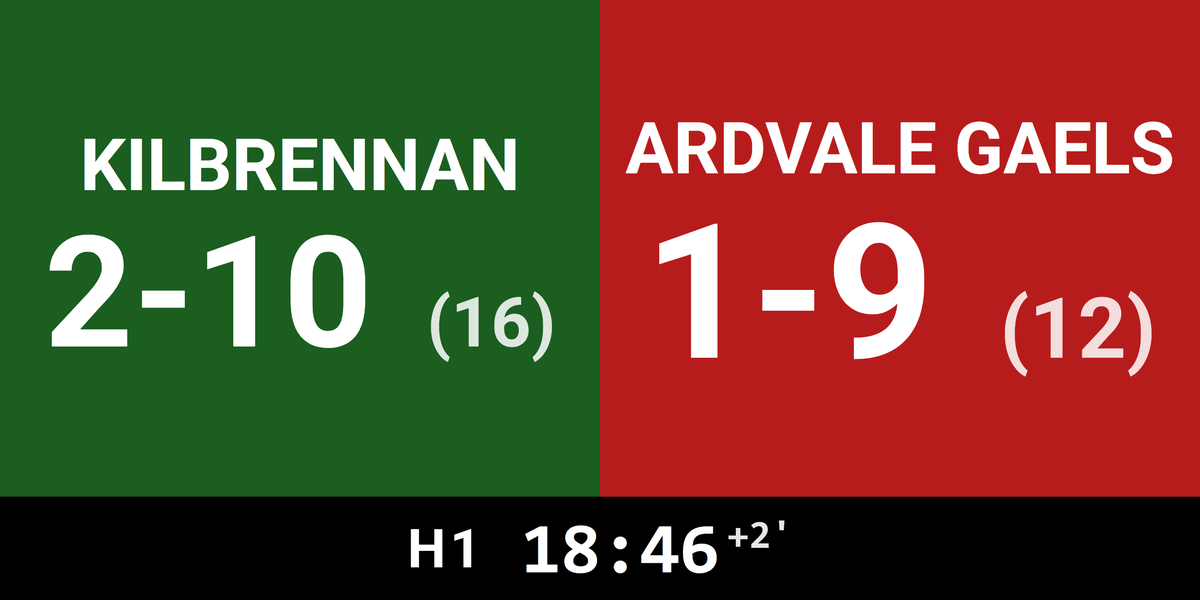
A Gaelic football scoreline like 2-10 to 1-9 confuses almost everyone the first time. Two numbers per team, neither of which is "the score"? And since 2025 there's a third way to score that didn't exist for the previous 140 years. The system is actually simple once you know what each number means — this guide walks through it.
The two ways to score (plus the new third one)
Gaelic football is played with H-shaped posts: a soccer-style goal with a net below the crossbar, and rugby-style uprights above it. That shape gives you the two classic scores:
- A goal — the ball goes into the net, under the crossbar. Worth 3 points. The umpire waves a green flag.
- A point — the ball goes over the crossbar, between the posts. Worth 1 point. The umpire waves a white flag.
Since the 2025 rule changes there's a third:
- A two-pointer — a kick sent over the bar from on or outside the new 40-metre arc. Worth 2 points. The umpire waves an orange flag.
That's the whole scoring vocabulary: green flag 3, orange flag 2, white flag 1.
How to read a GAA scoreline
Scores are always written as goals-points, in that order:
- 2-10 means 2 goals and 10 points
- Total value: 2 × 3 + 10 = 16 points
So in a match that finishes 2-10 to 1-9, the first team has 16 points and the second has 12 — a four-point win. Broadcasters and match reports often add the total in brackets, like 2-10 (16), and that habit has spread since two-pointers made the mental arithmetic harder: a "10" in the points column might now be six whites and two oranges.
Two quirks worth knowing:
- The goals number is small but heavy. 1-2 beats 0-4 (5 points vs 4) even though the second team scored more times.
- Commentators say it as "two ten" — the dash is silent.
The two-pointer, in detail
The two-point score arrived in 2025 from the GAA's Football Review Committee — the biggest scoring change in the sport's history — and was written permanently into the rule book for 2026. The current rules:
- The kick must be struck from on or outside the 40m arc — the kicker's standing foot on the line still counts.
- It applies to shots from open play, from a free, or from a "solo-and-go" — but not to 45s or sideline kicks, which stay worth one.
- The ball may bounce over the bar and still count for two.
- If a teammate of the kicker touches the ball in flight, it drops back to one point.
The tactical effect has been big: teams now keep a long-range kicker on the pitch specifically to hunt oranges, and a six-point lead — once "two goals clear" — can vanish in three kicks.
Match structure: halves, the clock, injury time
A Gaelic football match is two halves. Club matches play 30-minute halves; senior inter-county matches play 35. The clock counts up, like soccer, and runs into injury time at the end of each half — the fourth official signals the added minutes, and play continues until the referee's whistle (or, at inter-county level, the public clock and hooter).
There's no draw-avoidance built into normal league play; championship knockout matches use extra time and, if needed, more from there.
What about hurling and camogie?
Hurling and camogie — the stick-and-ball codes — use the same goals-points system and the same notation: a goal under the bar is 3, a point over it is 1, and the scoreline reads goals-points. Two differences to keep in mind:
- There is no two-pointer in hurling. The 40m-arc score is a football-only rule.
- Scores run much higher — points from distance are routine, so a hurling final can finish 3-27 to 2-24 where a football final finishes 1-15 to 0-14.
If you can read a football scoreline, you can read a hurling one.
Quick reference: GAA scoring essentials
The three scores
- Goal — into the net, green flag, 3 points
- Two-pointer — over the bar from on/outside the 40m arc, orange flag, 2 points (football only; not from 45s or sidelines)
- Point — over the bar, white flag, 1 point
Reading the scoreline
- Written goals-points: 2-10 = 2 goals, 10 points = 16 total
- Goals first, always — 1-2 beats 0-4
- Brackets show the total: 2-10 (16)
The match
- Two halves: 30 min (club) or 35 min (senior inter-county)
- Clock counts up, with injury time at the end of each half
- Hurling and camogie: same notation, no two-pointer, higher scores
How GAA scoreboards display it
A GAA scoreboard shows the match the way the notation demands: each team's goals-points scoreline, optionally with the derived total in brackets, plus the match clock, the half, and an injury-time indicator when the board goes up.

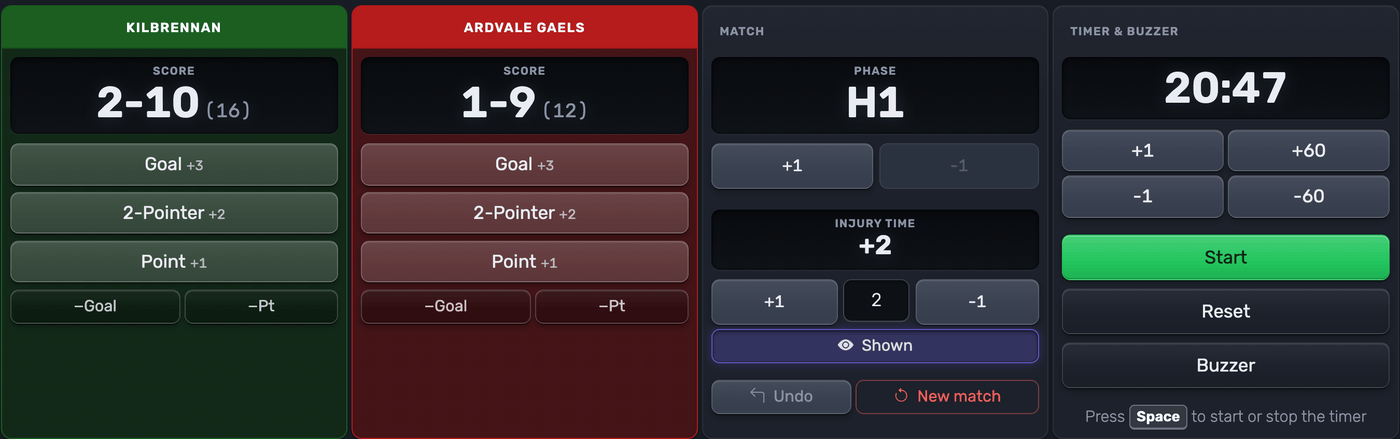
Running a club match, a tournament, or a stream? KeepTheScore's free online GAA scoreboard gives you one-tap buttons for goal, two-pointer and point — matching the umpire's flags — with a count-up clock, injury time, and layouts for OBS overlays, clubhouse TVs and LED panels. It works for hurling and camogie too.

Written by Caspar von Wrede
Founder of KeepTheScore. Building tools that help teams track scores and celebrate wins.