What is the follow-on in cricket? The rule explained
The cricket follow-on rule explained: the 200-run margin, how it appears on the scorecard, worked examples, and why modern captains often turn it down.
Article Contents

The follow-on is one of those cricket rules that sounds stranger the first time you hear it: a team can be forced to bat twice in a row. It only exists in two-innings cricket — Tests and other multi-day matches — and it hands one captain a genuinely difficult decision. This guide covers the rule itself, the numbers behind it, how it looks on a scorecard, and why the modern game has learned to fear it.
The follow-on in one sentence
If the team batting first finishes its innings far enough ahead — 200 runs or more in a Test — its captain can make the opposition bat again immediately, skipping their own second innings for now.
That's it. The trailing side "follows on": their two innings happen back-to-back, and the leading side doesn't bat again unless it has to.
When can a captain enforce the follow-on?
The rule is Law 14 of the Laws of Cricket, and the required first-innings lead scales with the length of the match:
| Match length | Lead required |
|---|---|
| 5 days or more (Tests) | 200 runs |
| 3 or 4 days | 150 runs |
| 2 days | 100 runs |
| 1 day (two-innings match) | 75 runs |
Three details people miss:
- Only the side that batted first can enforce it. If you bat second and lead by 300, there's no follow-on — the match just carries on in the normal order.
- It's an option, not an obligation. The captain chooses, and the choice is announced right after the first innings ends.
- If the first day of a match is completely washed out, the match is treated as a shorter one, and the required lead shrinks accordingly.
A worked example
Say Team A bats first and piles up 500. Team B replies with 264 — a deficit of 236, comfortably past the 200-run threshold. Team A's captain enforces the follow-on, and Team B walks straight back out to bat.
On the scorecard, Team B's line now reads like this:
Team A  500
Team B  264 & 118/3 (f/o)
The & separates the two innings, and (f/o) marks the second one as a follow-on innings. Team B is still 118 runs short of making Team A bat at all: 236 behind on the first innings, minus 118 scored so far. Wipe out the deficit and anything on top becomes the target Team A must chase in the fourth innings.
If reading 264 & 118/3 feels cryptic, our guide to cricket scoring breaks down the whole notation from scratch.
Why enforce it?
The case for the follow-on is mostly about time. A two-innings match can end in a draw if the clock runs out, so a captain 200+ ahead wants results, not rain delays:
- It buys overs. Skipping your second innings can save the best part of a day — often the difference between forcing a result and watching a draw.
- Momentum is real. A side bowled out cheaply must immediately do it all again, against bowlers with their tails up.
- Weather looms. If storms are forecast for day five, pressing on now may be the only path to a win.
Why captains increasingly don't
For a rule that offers a shortcut to victory, the follow-on gets turned down remarkably often in the modern game. Two reasons:
- Bowler fatigue. Enforcing it means your bowlers attack again with no rest. Back-to-back innings in the field can wreck an attack for the rest of a series.
- Batting last is dangerous. Pitches deteriorate. Declining the follow-on lets you bat again while the surface is still decent and leaves the opposition the worst of it.
And then there are the ghost stories. Only four teams in nearly 150 years of Test cricket have won after following on — and every one of those defeats haunts the captain who enforced it:
- England v Australia, Sydney 1894 — the first ever.
- England v Australia, Headingley 1981 — Ian Botham's 149 not out, then Bob Willis taking 8 for 43.
- India v Australia, Kolkata 2001 — VVS Laxman's 281 turns a follow-on into one of the greatest comebacks in the sport.
- New Zealand v England, Wellington 2023 — New Zealand win by a single run.
Four losses out of hundreds of enforcements is a tiny risk on paper. But each one was so famous, so total in its humiliation, that captains still weigh the follow-on like it's loaded.
How the follow-on changes the scoreboard maths
In a normal two-innings match the innings alternate: A, B, A, B. The follow-on rearranges them to A, B, B — and only if needed — A.
That changes what the numbers on the board mean:
- While the follow-on innings is live, the chasing number is the first-innings deficit. Team B at
264 & 118/3 (f/o)against 500 is still 118 runs from parity. - If the following-on side clears the deficit, every extra run builds a fourth-innings target for the side that enforced it.
- If they don't clear it — bowled out twice without catching up — the match ends immediately in an innings defeat, the heaviest result in cricket. That's where scorelines like "won by an innings and 46 runs" come from.

Scoring your own two-innings matches
If you score club or social cricket, the two-innings format is no longer just for the professionals — declaration games and mini-Tests are a staple of weekend cricket. Our free cricket scoreboard supports 2 innings each side: it shows two-innings scores the standard way (250 & 180/4), works out the final-innings target from the overall lead across both innings, and records a draw if you end an unfinished match — just like the real thing. There's a full walkthrough in the cricket scoreboard guide.
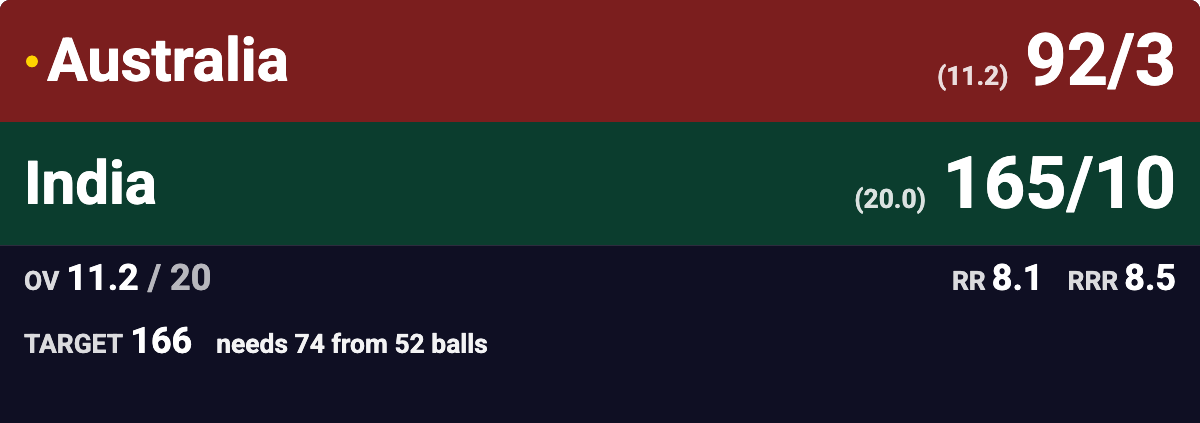 The full scoreboard layout — set "2 innings each" in the match format to score a Test
Follow-on FAQ
What is the follow-on score in Test cricket?
A lead of 200 runs or more after the first innings. Bowl the opposition out 200+ behind your total and the follow-on becomes available.
Can a captain decline the follow-on?
Yes — it's entirely optional. Declining it simply means the match continues in the normal batting order, with the leading side batting again.
Is there a follow-on in ODIs or T20s?
No. The follow-on only exists in two-innings formats. One-day and T20 cricket give each side a single innings, so the rule never applies.
How many teams have won after following on?
Four, in the entire history of Test cricket: England (1894 and 1981), India (2001), and New Zealand (2023). Following on is nearly always a losing position — which is exactly why those four wins are legendary.
What does (f/o) mean on a cricket scorecard?
It marks a follow-on innings — the side batted again immediately after their first innings because the opposition enforced the follow-on.

Written by Caspar von Wrede
Founder of KeepTheScore. Building tools that help teams track scores and celebrate wins.