Glance up at a hockey scoreboard and you'll see more than just a score. There's a countdown clock, penalty time ticking away for one team, a "PP" flashing somewhere, and a shot counter that keeps climbing. The score might be 2-1, but those other numbers tell you whether the game is actually close or about to blow open.
Hockey scoreboards move fast because the game moves fast. This guide breaks down every element you'll see — whether you're in the arena, watching on TV, or trying to figure out what your kid's rec league scoreboard is showing.
The Score
Two numbers. Home team on one side, away team on the other. In most arenas, the home team is on the right or bottom. On TV broadcasts, conventions vary — some networks put the home team on top, others on the bottom.
Hockey is low-scoring compared to most sports. A 3-2 game is competitive. A 5-1 game is a blowout. Seeing 0-0 in the second period is completely normal, not a sign that nothing is happening.
For a breakdown of how goals actually work — what counts, what gets disallowed, and how assists factor in — see our guide to hockey scoring.
The Period Clock
Hockey is played in three 20-minute periods, and the clock counts down. When you see "14:37" on the board, that means 14 minutes and 37 seconds remain in the current period.
The clock stops for:
- Goals (for the celebration and faceoff)
- Penalties
- Puck leaving the playing surface
- Offside and icing calls
- Timeouts
- TV commercial breaks (in professional hockey)
Between periods there's an intermission — 17 minutes in the NHL, though it can stretch longer for ice resurfacing. The period indicator (1st, 2nd, 3rd) tells you where you are.
If the game is tied after three periods, it goes to overtime. The clock resets for a new period. In the regular season that's a 5-minute period; in the playoffs it's a full 20 minutes, and they keep playing additional periods until someone scores.
Penalty Time
This is the element that makes hockey scoreboards unique. When a player commits a penalty — tripping, hooking, slashing, roughing — they sit in the penalty box for a set amount of time. The scoreboard shows exactly how much time remains on each penalty.
How penalty time displays work
You'll see the penalized player's number and a countdown. Common penalty lengths:
- Minor penalty: 2 minutes
- Double minor: 4 minutes (two consecutive 2-minute penalties)
- Major penalty: 5 minutes
If a team takes multiple penalties, the scoreboard stacks them. You might see two separate countdowns running simultaneously for the same team. That's when things get interesting for the opponent.
The penalty clock counts down independently of the game clock during stoppages. When a minor penalty team gets scored on, the remaining penalty time evaporates and the player leaves the box. Major penalties run their full duration regardless of goals scored.
Power Play Indicators
When one team has a player in the penalty box, the other team has more skaters on the ice. That's a power play, and scoreboards highlight it clearly — usually with "PP" or "POWER PLAY" lit up next to the team that has the advantage.
Common power play situations:
- 5-on-4: One penalty, the standard power play
- 5-on-3: Two penalties on the same team simultaneously — a massive advantage and often a guaranteed goal
- 4-on-3: One penalty during overtime (which is played 3-on-3 in the regular season)
The power play indicator disappears once the penalty expires or the advantaged team scores (on a minor penalty). Watch the penalty timer count down — if it hits zero, teams return to even strength.
Shots on Goal
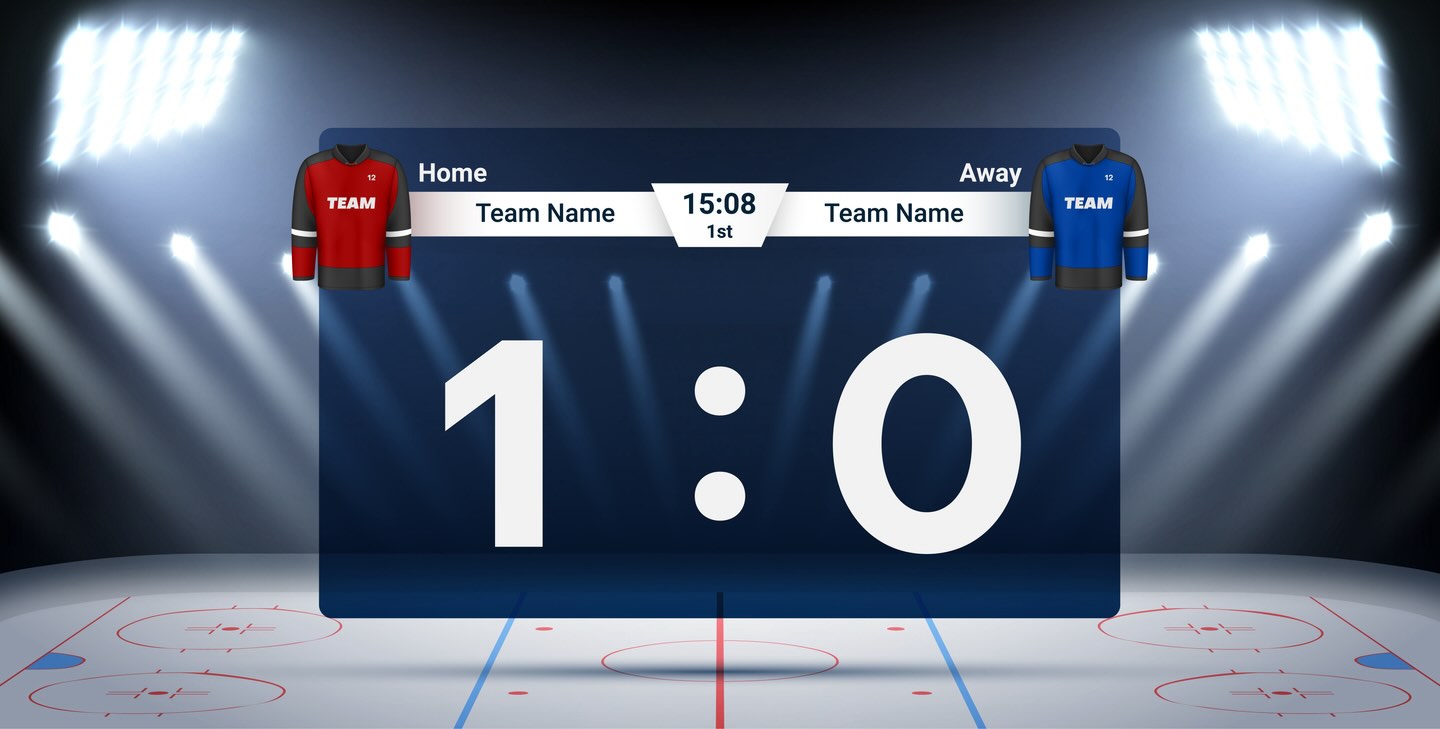 A hockey scoreboard display showing score, period, and game time
The shot counter tracks how many times each team has directed the puck at the opposing net (and the goalie had to make a save or a goal was scored). Shots that miss the net or hit the post don't count.
Why does this matter? Shot totals reveal the flow of the game. A team might be losing 1-0 but outshooting the opponent 28-12 — that tells you they're dominating play and one bounce could change everything. Conversely, a team winning 2-0 on just 8 shots is living dangerously.
Broadcasts and arena boards update shot counts after each stoppage, not in real time.
Arena Scoreboards vs TV Broadcasts
At the Arena
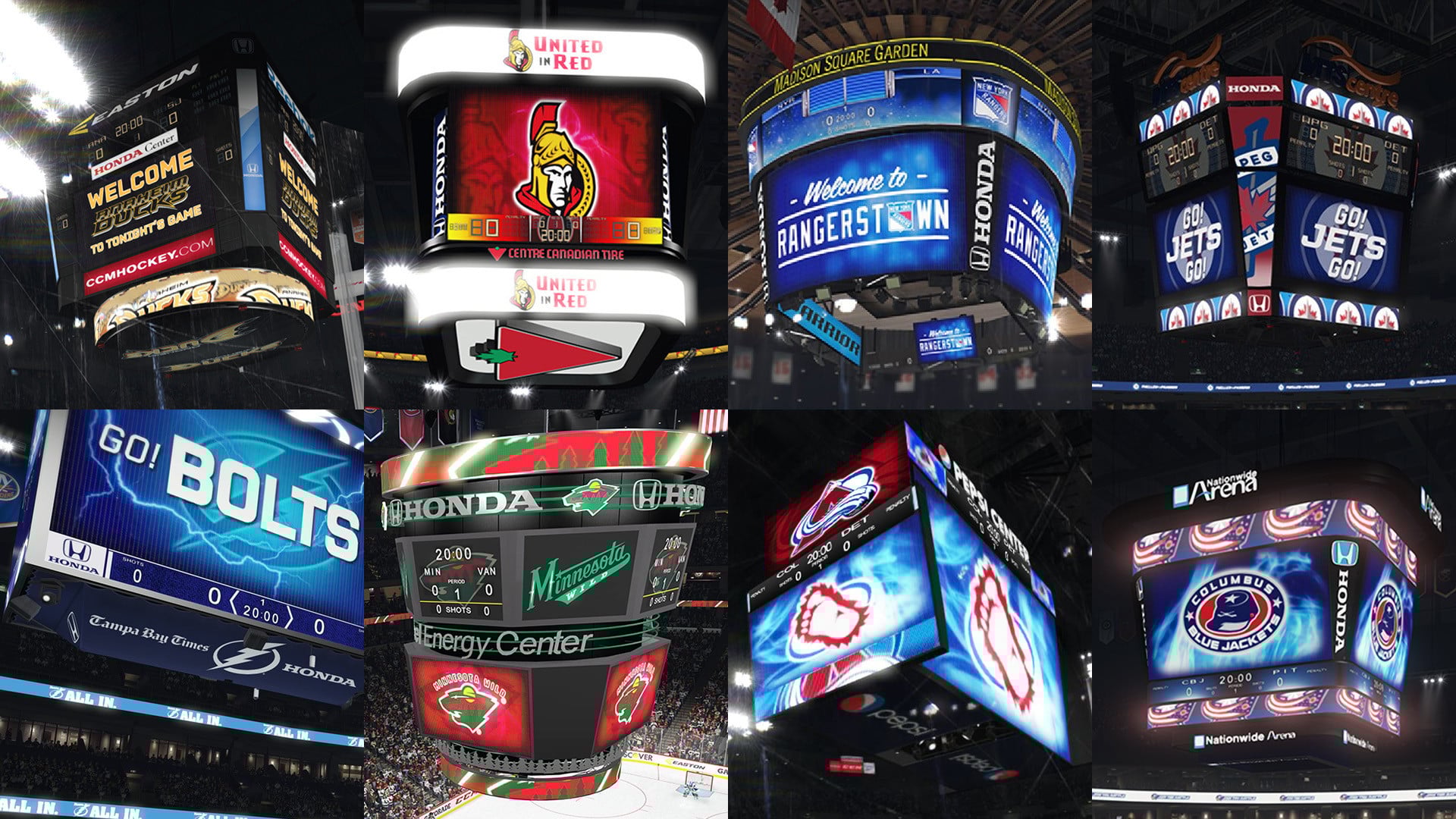
Most NHL arenas use a center-hung jumbotron — a four-sided video display visible from every seat. These show:
- Score and period
- Game clock (the biggest numbers)
- Penalty countdowns
- Shots on goal
- Power play status
- Replays and player stats between whistles
Smaller rinks (college, junior, rec leagues) have simpler wall-mounted boards. Some show only score, period, and time. Penalty tracking might be a whiteboard near the penalty box.
On TV
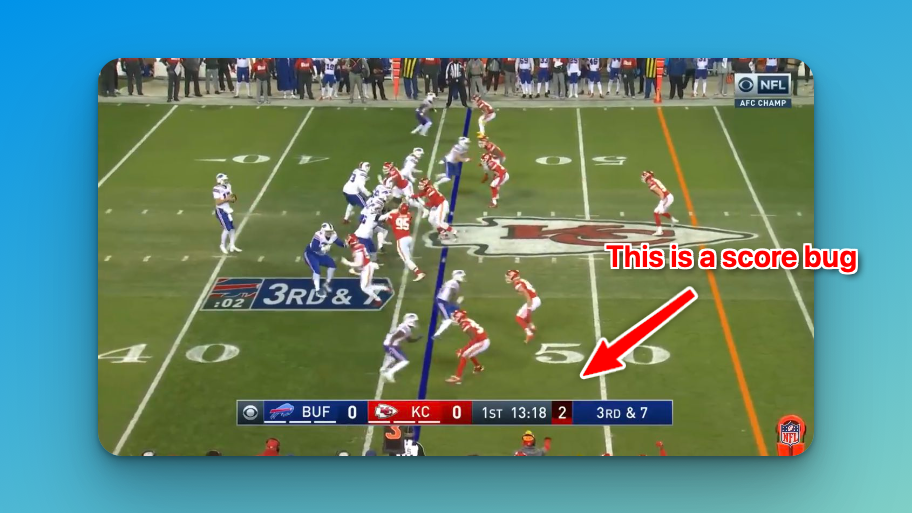
Broadcast score bugs are compact overlays that sit in a corner of the screen. They pack in the essentials:
- Team abbreviations and score
- Period and game clock
- Power play indicator with remaining time
- Sometimes shots on goal
The full penalty breakdown usually appears as a pop-up graphic when a penalty is called, then disappears. TV directors know most viewers just want score, time, and whether someone has a power play. The details come through the commentary.
For more on how broadcast overlays work across sports, see our post on score bugs in live sports broadcasts.
Reading the Game Through the Scoreboard
The numbers tell a story once you know what to look for.
Penalty time stacking up for one team? The other team is about to get sustained offensive pressure. Shot count heavily lopsided? The team with fewer shots is relying on their goalie to steal the game. Clock under two minutes in a one-goal game? Watch for the trailing team to pull their goalie for an extra skater — you'll see a brief 6-on-5 situation that creates chaos.
Coaches glance at the scoreboard constantly. Penalty time remaining determines line matchups. Shot counts influence whether to play aggressively or protect a lead. Even the game clock changes strategy — teams play differently with a two-goal lead and 15 minutes left versus 5 minutes left.
Running Your Own Scoreboard
Need a scoreboard for your league? KeepTheScore's hockey scoreboard handles the essentials — score, periods, and game flow — and runs on any device. Pair it with a TV or projector for a professional-looking setup at a fraction of the cost of dedicated hardware.
Streaming games? You can add a scoreboard overlay to your broadcast.
Hockey scoreboards look busy because hockey is busy. But it all breaks down to a handful of elements: who's winning, how much time is left, who's in the box, and who's outshooting whom. Once you start tracking those four things, the rest of the game makes a lot more sense.
Related: How hockey scoring works — goals, assists, player points, and the NHL standings system.