The Challenge: $2,500 Tournaments Parents Can't Attend
When Alex became technology director at International School Seoul in South Korea, he faced a problem endemic to international school athletics: tournaments cost families thousands of dollars, yet parents couldn't watch their kids play.
"I would ballpark maybe $2,500 to send your kid for four or five days across the world to play in this conference. And that's us trying to keep the cost down by having the kids sleep at the school."
— Alex, Technology Director
The trips weren't just athletics—students visited cultural sites, attended sumo matches in Japan, rode horses on the Mongolian steppe. But at $2,500 per student, parents who paid that much wanted one thing: to see their kids compete.
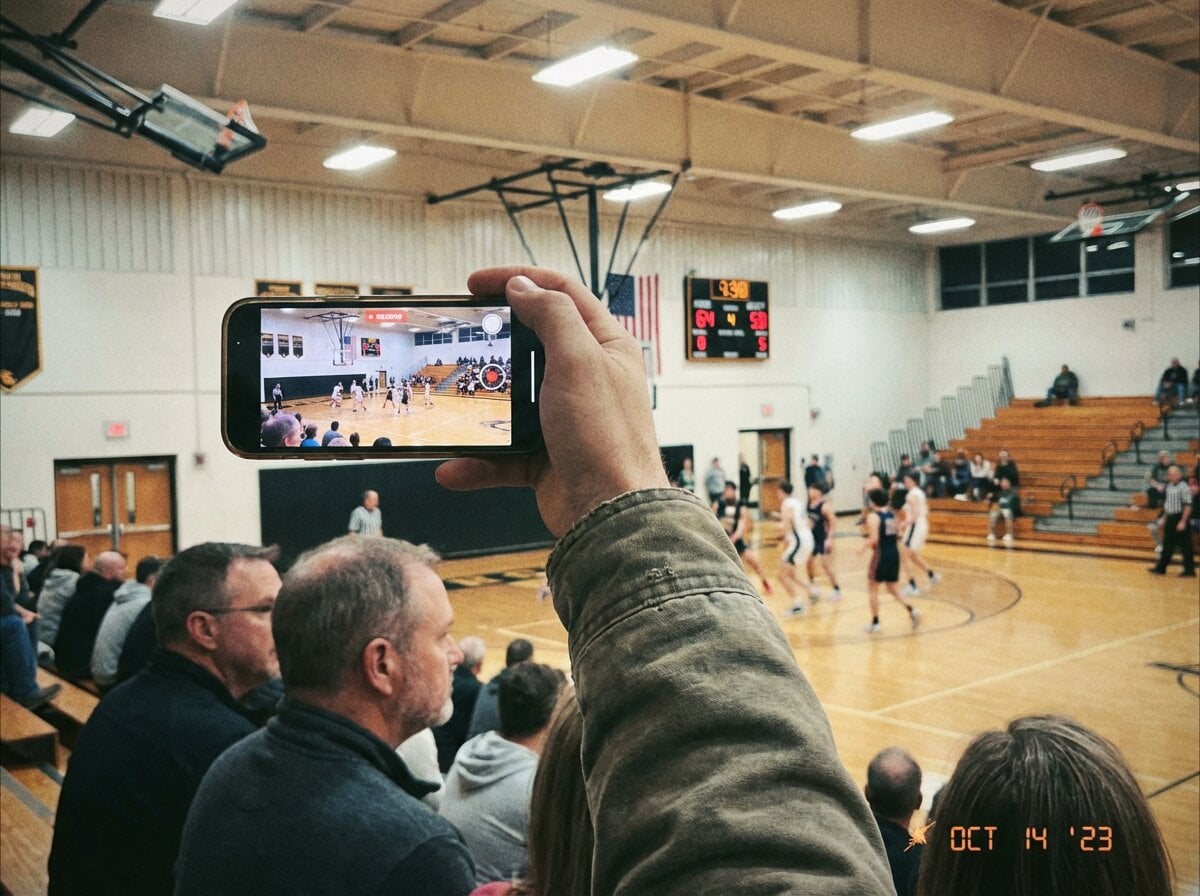 A parent captures their child's international school basketball game, knowing family back home is eagerly waiting to watch the action unfold
The existing conference structure made things worse. International School Seoul competed in a league with giant Korean schools (five times their athlete pool) and tiny micro-schools that couldn't host their own events.
"We would have these tournaments and some schools would participate would be way too small to ever put on their own events," Alex recalls. "And then some of the bigger schools were way too competitive for us to actually ever be able to compete with."
In 2021, Alex and three other similar-sized international schools (in Seoul, Tokyo, Osaka, and Ulaanbaatar) broke away to form their own conference. When forming the new conference, all four schools agreed: there would be quality live-streaming.
"There was an agreement amongst all the four schools that there would be a quality live-streaming component to this so that parents could follow along, so that coaches who could not attend could see how their kids performed, and that the teams themselves could watch it and get a valuable artifact out of participating in the event."
Alex was put in charge of live-streaming for tournaments hosted at Seoul. That's when the search for scoreboard software began.
Finding the Right Solution: A Day-Long Decision
Alex's procurement process moved quickly—by design.
"If I had to put a time on it, maybe a day," he says about the decision. "You got to keep in mind I spend a lot of money and I evaluate a lot of tools. So these decisions have to be made."
The Network Effect:
Rather than broad internet searches, Alex tapped his trusted tech director network—a private Google Chat group of technology directors at international schools in Korea.
"When you have a strong network of colleagues who are all thinking about similar issues and testing similar things, this is usually best to go to them directly and say, 'What are you using?' And that allows you to filter through the options pretty quickly."
The group operates on a strict no-sales policy: "It's really important that in these groups, there's no sales people or that it's really just us as the leadership to talk about what are we seeing, what's working."
Through this network, Alex narrowed his evaluation to two or three options. KeepTheScore stood out.
What Made The Difference:
"I think the thing that struck me about it was just how simple it was. So user-friendly to use and to set up."
But simplicity alone wasn't enough. Alex needed a specific feature: two-level access control for managing student operators.
"The thing I really liked about it was the idea that there's an admin side of it to change names and fonts and colors and logos and parameters. And then there's the scorekeeper link where you could just give it to the referee or the score club, the kids who are on the side, and that they can take ownership and actually keep the score and run the game and they're making the calls, but they're not also able to wipe history or change team names or things like that."
This wasn't about control—it was about student empowerment:
"I think it's a huge component in EdTech software is the idea of empowering kids and saying, 'You are actually running the score here.'"
The Evaluation Criteria:
Alex's search query to his network: "I'm looking for something simple and clean and easy to use."
The criteria weren't for his own benefit: "Definitely for the other users, for the students and for the purposes of longevity." He needed a streaming-ready scoreboard that students could operate independently.
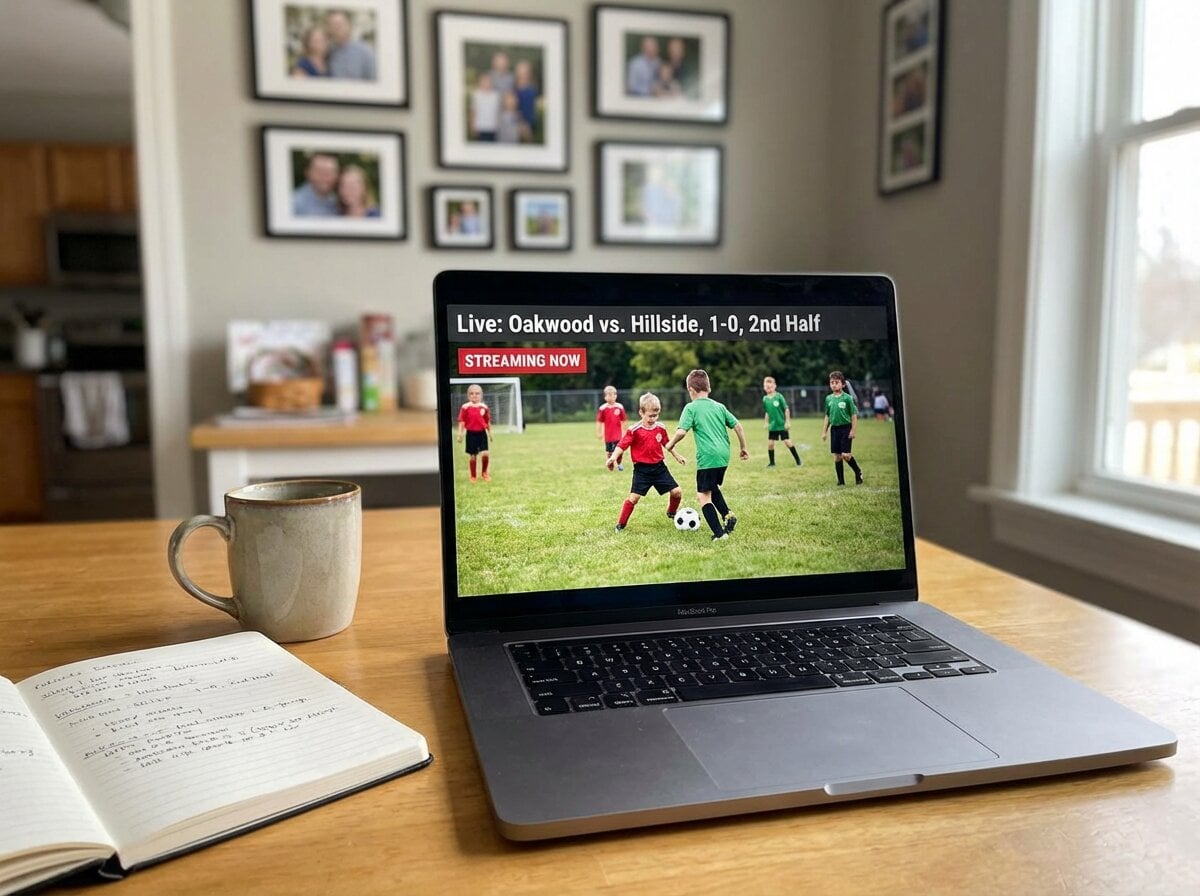 Grandparents thousands of miles away can watch their grandchild's basketball tournament live—bridging the distance between international school families
Longevity matters in international schools:
"In most international contexts, the average teacher stays for about four years at a school, so it's a significant turnover rate. And so you need to have tools in place that can be easily transferred from one staff member to the next."
Alex had seen it before: talented people build impressive custom systems, then leave the school. The entire structure disappears.
"If it is a more complicated system that no one understands, it will just be gone when that person leaves."
The Price Factor:
When the decision went to Alex's director, price helped:
"It's very cheap by ed tech standards. So that also just means we're happy to just roll it over year to year and it's not as complicated as a decision as other tools."
The first year, Alex purchased an annual subscription. Year two, they switched to pay-as-you-go. Now it's on the permanent subscription list.
The Implementation: Students Running The Show
The Technical Setup:
Alex's setup for tournament streaming:
- Platform: OBS (Open Broadcaster Software) streaming to YouTube
- Cameras: Positioned on fourth floor to capture entire soccer field
- Scoreboard: KeepTheScore embedded as browser source overlay (perfect for basketball, soccer, volleyball, and other school sports)
- Account structure: Shared account not tied to individual staff
- Documentation: Spreadsheet with hex codes, logos, admin links, scorekeeper links
"I remember we made a nice spreadsheet of all the hex codes for the official colors and logos so that the kids could find them really quickly and update them really well. And then on the same spreadsheet that had all the logos and colors, we also added the admin link and the scorekeeping link all in one place."
Student Training:
 Students gather in the cafeteria to support their classmates competing across Asia—technology bridging thousands of miles to bring the team together
Alex ran 4-5 lunchtime sessions leading up to tournaments, covering:
- Live stream setup
- Account linking
- Troubleshooting cameras
- Embedding scoreboards
- The final two sessions focused specifically on scoreboard operation
Two groups of students trained separately:
- Admin group: Setting up boards, changing team names/logos
- Scorekeeper group: Running scores during games
Why Students Run It:
With KeepTheScore, students could genuinely own scorekeeping:
"I think it was really good that with KeepTheScore, they could actually run the show, which was great."
Weekend Tournaments:
Student independence is critical for weekend tournaments. Alex monitors remotely via Google Chat and by watching the YouTube stream itself: "I will often catch problems before they do."
But the goal is minimal intervention during tournament days.
The Results: Conference-Wide Adoption and Zero Churn
Complete Market Penetration
When asked if the other schools in the conference use KeepTheScore, Alex pauses:
"It's a small conference, so it's only four other schools, and I believe I've only ever seen KeepTheScore being used."
All four schools—Seoul, Tokyo, Osaka, and Ulaanbaatar—appear to stream with the same scoreboard system. Organic standardization through quality.
Zero Switching Intent
After two years of use:
"I know there's zero thoughts right now about changing software next year. I think everyone involved in the live-streaming and sporting aspect really appreciates, like I said, the simplicity, the use of it, the fact that students can... It's built in such a way that students can really take it over and just own it."
For a small school, student ownership isn't a luxury—it's necessity:
"It's a huge relief on a small school."
Embedded Scoreboards Beyond Streaming
The conference discovered an unexpected use case: embedding live scoreboards on their conference website.
"We definitely have the live scoreboards on the website," Alex notes. This allows teachers and parents to check scores without watching full streams—crucial for busy school days.
"If you're teaching six classes in that day, you're not watching the live stream... but you want to just be able to go and really quickly check in and see where the team is at when they are playing."
Positive User Feedback
"I think the feedback has been super positive... I think the kids really enjoy the customization element of it as well. And it's been largely super positive."
Moving Schools, Taking The Tool
When Alex transferred to International School Vienna in 2025, KeepTheScore came up immediately:
"Would I be interested in using your guys' product again at the current school? Absolutely, for sure."
Though Vienna's school has a more established setup (created their own conference 6-8 years earlier with heavier camera/cabling investments), Alex sees potential:
"Before I'd ever make that call, especially as a new person coming in, I really need to chat with the athletics director and make sure that there was a need to change or an appetite to change, and I would happily offer this one up."
Why It Works for International Schools
International schools face unique constraints that make simple, transferable tools essential:
High turnover (4-year average tenure) means software selection is succession planning. Complex custom solutions die when creators leave.
Tournament economics ($2,500 per student) create pressure: when streams fail, parents express frustration because they paid thousands to watch remotely.
Sports as identity: Athletic programs drive enrollment decisions. Quality streaming demonstrates institutional investment and professionalism.
Technical reality: OBS is already complex ("above 90% of most people"), making scoreboard simplicity non-negotiable:
"There is so much complexity in live-streaming already. Just having the scoreboard be clean and simple and work well and easily and anyone can figure it out is hugely appreciated."
Key Takeaways
Critical Success Factors:
- Network-driven decisions: Tech director peer groups filter options faster than internet searches—zero-sales-policy networks provide trusted recommendations
- Survival through turnover: In international schools (4-year average staff tenure), tools must be simple enough to transfer between staff members
- Student empowerment architecture: Two-level access (admin vs operator) enables true student ownership while protecting critical settings
- Tournament economics: When families invest $2,500 per event, quality live-streaming becomes a non-negotiable value proposition
Technical Implementation Insights:
- Shared accounts (not tied to individuals) ensure continuity beyond staff changes
- Remote monitoring strategy: Google Chat + watching your own YouTube stream catches problems before students notice
- Documentation matters: Centralized spreadsheets with hex codes, logos, and access links enable rapid tournament setup
- 4-5 lunchtime training sessions split between admin and scorekeeper groups creates sustainable operations
Looking Forward
As Alex moves to International School Vienna in 2025, he's already considering KeepTheScore for their athletics program—demonstrating how international school tech directors carry successful tools between institutions.
"I think that's a huge component in EdTech software is the idea of empowering kids and saying, 'You are actually running the score here.'"
The pattern these schools established—organic cross-school standardization through quality, student-run weekend operations, and tools that survive staff turnover—offers a blueprint for international school conferences worldwide.
Running international school athletics or tournaments? Get started with KeepTheScore and see why schools across Asia trust it for student-run live-streamed competitions.